
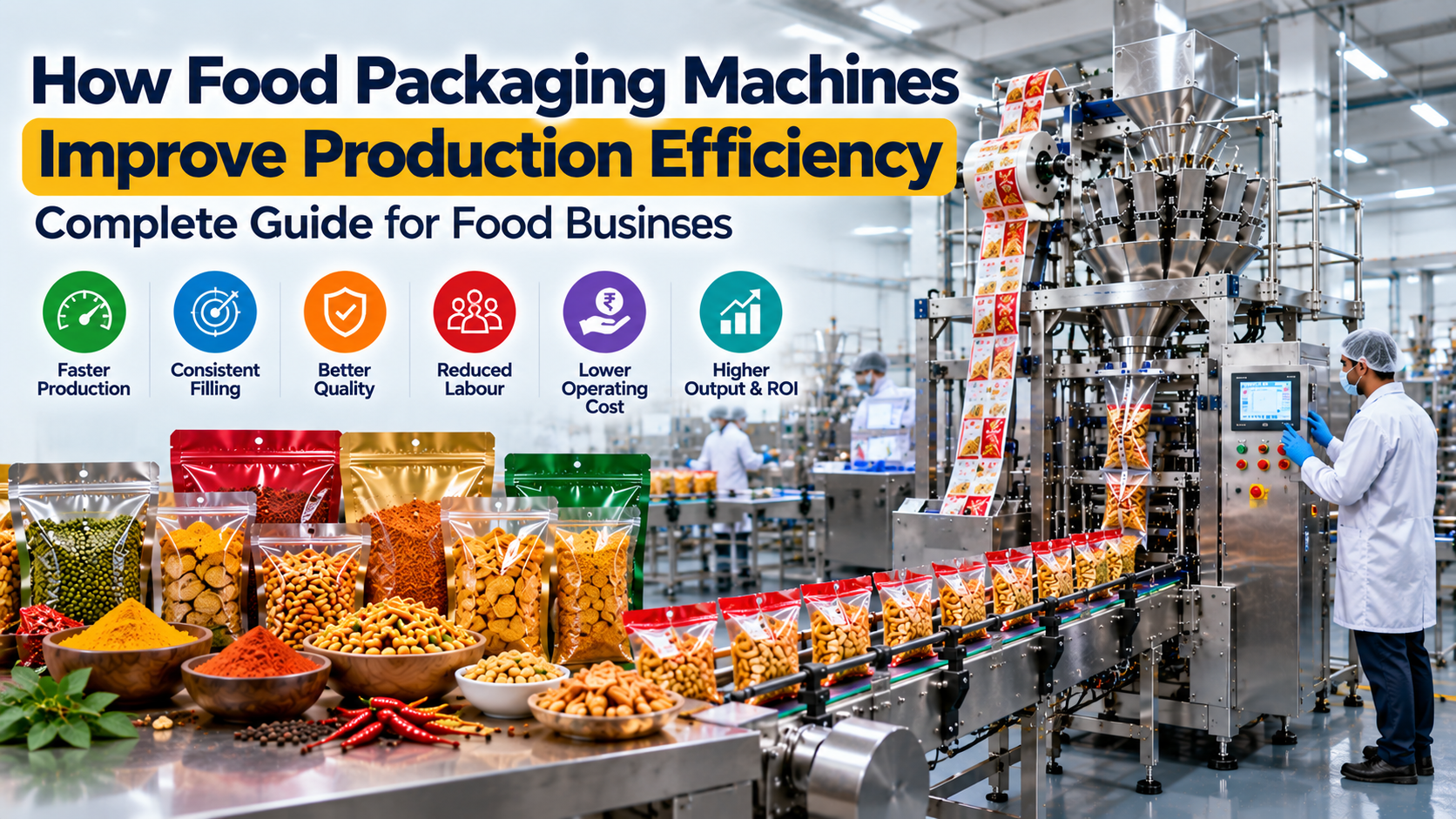
In today’s competitive food processing industry, businesses need to produce high-quality products while maintaining speed, accuracy, and cost efficiency. Traditional manual packaging processes can require significant labour, take more time, and may result in inconsistent packaging.
Food packaging machines provide an efficient solution by automating important packaging operations such as weighing, filling, sealing, and conveying. By reducing manual intervention and improving process consistency, modern packaging machinery can help food businesses increase productivity and manage growing production demands.
What Is Production Efficiency?
Production efficiency means producing the required quantity of products using available resources such as time, labour, materials, energy, and machinery in an effective manner.
In food packaging, efficiency can be improved by:
- Increasing packing speed
- Reducing manual labour
- Improving filling accuracy
- Minimizing product wastage
- Maintaining consistent packaging quality
- Reducing production downtime
- Improving workflow
Food packaging machines can contribute to these improvements by automating repetitive packaging operations.
1. Faster Packaging Operations
One of the biggest advantages of packaging machinery is increased production speed.
Manual weighing, filling, and sealing can take considerable time, especially when production volumes are high. Automated machines can perform these operations continuously and at a consistent speed.
This allows businesses to process more products within the same working period and improve overall production output.
2. Reduces Manual Labour
Packaging involves several repetitive activities, including measuring products, filling packages, sealing pouches, and transferring finished packs.
Automation reduces the amount of manual work required for these repetitive operations.
Instead of having multiple workers perform the same tasks throughout the production process, operators can supervise and control the machinery.
This can help businesses use their workforce more efficiently.
3. Improves Filling Accuracy
Accurate filling is particularly important in the food packaging industry.
Manual filling can sometimes result in variations in the quantity of product placed inside each package. Automated weighing and filling systems are designed to provide more consistent quantities.
Improved filling accuracy can help:
- Reduce product giveaway
- Maintain consistent pack weights
- Improve customer satisfaction
- Reduce unnecessary material usage
4. Reduces Product Wastage
Product wastage can increase operating costs.
Modern packaging machines can control filling and packaging operations more precisely, helping reduce unnecessary product loss during the packaging process.
For businesses handling large production volumes, even a small reduction in wastage can make a meaningful difference over time.
5. Provides Consistent Packaging Quality
Consistency is important for food brands.
Customers expect packages to have similar weights, sealing quality, appearance, and overall presentation.
Automated packaging machines can perform repetitive operations with consistent settings, helping businesses maintain uniform packaging across large production batches.
6. Improves Sealing Quality
Proper sealing is essential for protecting packaged food products.
A suitable packaging machine can provide controlled and consistent sealing conditions according to the packaging material and product requirements.
Consistent sealing can help protect products from external exposure and maintain the quality of the package during storage and transportation.
7. Reduces Production Downtime
Unplanned downtime can affect production schedules and increase operational costs.
Reliable packaging machinery, combined with proper preventive maintenance, can help businesses reduce avoidable interruptions.
Manufacturers should also consider spare parts availability and technical service when selecting packaging machinery.
Regular maintenance can help identify potential problems before they result in major production interruptions.
8. Improves Workflow
Packaging machines can be integrated with other equipment such as conveyors, feeders, weighing systems, and coding machines.
This allows different stages of the packaging process to work together more efficiently.
For example, a production line may include:
Product Feeding → Weighing → Filling → Sealing → Coding → Conveying
Connecting these processes can reduce unnecessary manual handling and create a smoother production workflow.
9. Supports Higher Production Volumes
As a business grows, its packaging requirements also increase.
A packaging process that works for a small production volume may become inefficient when demand increases.
Automated packaging machinery can help businesses handle higher production volumes without increasing manual packaging work at the same rate.
The appropriate machine capacity should be selected according to current requirements as well as expected future growth.
10. Better Use of Workforce
Automation does not simply reduce manual work; it can also allow employees to focus on tasks that require supervision, quality checking, machine operation, and production management.
This can help businesses make better use of their workforce and improve overall operational efficiency.
11. Helps Maintain Hygiene
Hygiene is particularly important in food processing and packaging.
Reducing unnecessary manual handling can help create a more controlled packaging process. Machines designed with appropriate food-contact materials and easy-to-clean components can also support better hygiene practices.
Businesses should always select machinery according to their specific product and applicable food safety requirements.
12. Supports Multiple Packaging Requirements
Modern packaging machinery can be configured for different products and packaging formats depending on the machine design.
Businesses may use suitable equipment for products such as:
- Spices
- Pulses
- Rice
- Flour
- Grains
- Snacks
- Dry fruits
- Seeds
- Granular products
- Powder products
The machine configuration should be selected according to the product characteristics, pack size, filling range, and production requirements.
13. Helps Control Operating Costs
Improved production efficiency can contribute to better cost control.
By increasing output, reducing wastage, improving filling accuracy, and reducing repetitive manual work, packaging machinery can help businesses manage their operational resources more effectively.
However, the actual cost benefits depend on factors such as machine capacity, production volume, product type, labour costs, energy consumption, and maintenance requirements.
Manual Packaging vs. Machine Packaging
| Factor | Manual Packaging | Machine Packaging |
|---|---|---|
| Production Speed | Generally lower | Generally higher |
| Filling Consistency | Can vary | More consistent |
| Labour Requirement | Higher | Lower for repetitive tasks |
| Product Wastage | Can be higher | Can be reduced |
| Packaging Consistency | Depends on operator | More consistent |
| Large-Scale Production | More difficult to manage | Better suited |
| Process Automation | Limited | Higher |
The right choice depends on the production scale, product type, budget, and packaging requirements of the business.
How to Select a Packaging Machine for Better Efficiency?
Before purchasing a food packaging machine, businesses should consider:
Product Type
Understand whether the product is powder, granular, liquid, solid, or another form.
Production Capacity
Determine the required packs per minute and daily production target.
Packaging Format
Identify the required pouch, bag, container, or other packaging format.
Automation Level
Choose between semi-automatic and fully automatic equipment according to the production requirements.
Filling Accuracy
Select a suitable weighing or filling system for the required pack weight.
Machine Quality
Check machine construction, components, control systems, and product-contact materials.
Service and Maintenance
Consider warranty, spare parts availability, installation, training, and after-sales support.
Why Choose HIND Food Packaging?
HIND Food Packaging provides packaging machinery solutions designed for different food processing and packaging applications.
We understand that every business has different production volumes, products, packaging formats, and operational requirements. The right machinery should therefore be selected according to the specific application rather than using a one-size-fits-all approach.
Whether you are setting up a new food processing unit, upgrading existing equipment, or increasing production capacity, suitable packaging machinery can help create a faster and more consistent packaging process.
Conclusion
Food packaging machines can significantly improve production efficiency by increasing packaging speed, reducing repetitive manual work, improving filling accuracy, minimizing wastage, maintaining consistent packaging quality, and supporting higher production volumes.