
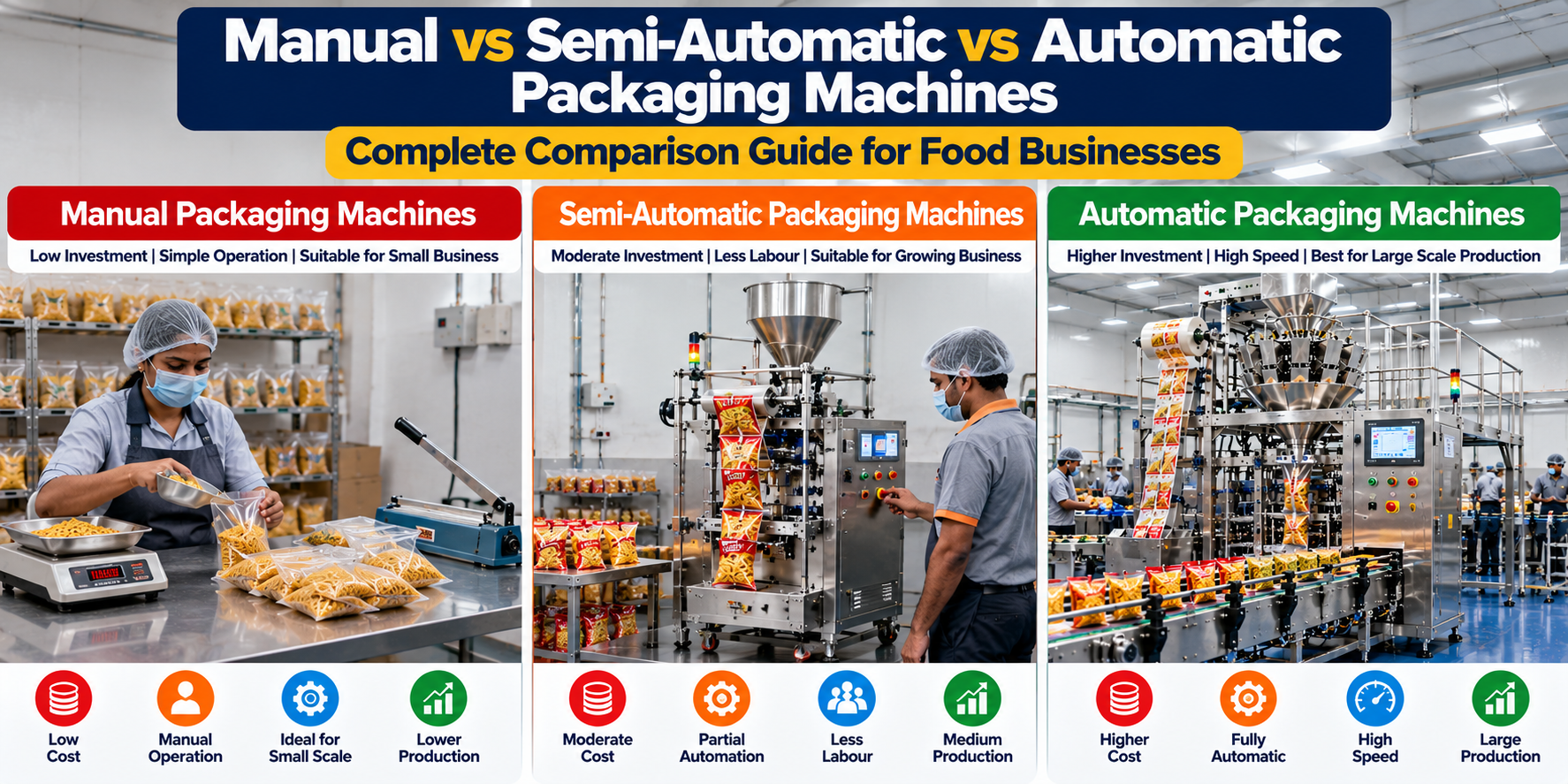
Choosing the right packaging machine is an important decision for any food processing or manufacturing business. The packaging system you select can affect production speed, labour requirements, packaging consistency, operating costs, and future growth.
Businesses generally have three main options: manual packaging, semi-automatic packaging machines, and fully automatic packaging machines.
Each option has its own advantages and is suitable for different production requirements. A small business may benefit from a simple manual or semi-automatic setup, while a high-volume manufacturing unit may require a fully automatic packaging line.
This guide explains the key differences between manual, semi-automatic, and automatic packaging machines to help you choose the right solution for your business.
What Are Manual Packaging Systems?
Manual packaging is a process in which most packaging operations are performed by workers.
Depending on the product, workers may manually weigh, fill, seal, label, and transfer the packaged products.
Manual packaging can be suitable for businesses with:
- Low production volumes
- Limited packaging requirements
- Small-scale operations
- Product testing or sampling
- Lower initial investment requirements
Advantages of Manual Packaging
- Lower initial equipment investment
- Simple operation
- Easy to start for small businesses
- Suitable for low production volumes
- Requires limited machinery infrastructure
Limitations of Manual Packaging
- Higher labour requirements
- Lower production speed
- Greater variation in filling and packaging
- More dependence on operator performance
- Difficult to manage at high production volumes
- Greater potential for manual handling errors
As production increases, businesses may eventually need to move from manual packaging to a more automated solution.
What Are Semi-Automatic Packaging Machines?
Semi-automatic packaging machines combine machinery with manual operations.
The machine performs important parts of the packaging process, while an operator may still need to feed products, position packaging, start the cycle, or perform other manual tasks depending on the machine design.
Semi-automatic machines can be a practical choice for growing businesses that need improved productivity without moving immediately to a fully automated production line.
Advantages of Semi-Automatic Packaging Machines
- Faster than completely manual packaging
- Reduced repetitive labour
- Better packaging consistency
- Suitable for small and medium-sized businesses
- Lower investment than many fully automatic systems
- Can be upgraded as production requirements grow
Limitations of Semi-Automatic Packaging Machines
- Still requires operator involvement
- Production capacity may be lower than a fully automatic system
- Manual feeding may be required
- Production speed can depend partly on the operator
Semi-automatic machinery can therefore provide a balance between investment, automation, and productivity.
What Are Automatic Packaging Machines?
Automatic packaging machines perform multiple packaging operations with minimal manual intervention.
Depending on the machine configuration, an automatic system can handle processes such as:
Feeding → Weighing → Filling → Sealing → Coding → Conveying
Automatic systems are generally suitable for businesses with higher production volumes and continuous packaging requirements.
Advantages of Automatic Packaging Machines
- High production efficiency
- Reduced manual intervention
- Consistent packaging
- Improved filling accuracy
- Suitable for higher production volumes
- Better integration with production lines
- Reduced repetitive labour requirements
Limitations of Automatic Packaging Machines
- Higher initial investment
- More complex installation
- Requires trained operators
- Maintenance and technical support are important
- May require more production space
For businesses with high and consistent production requirements, the increased automation can provide significant operational benefits.
Manual vs Semi-Automatic vs Automatic Packaging Machines
| Feature | Manual | Semi-Automatic | Automatic |
|---|---|---|---|
| Initial Investment | Lower | Moderate | Higher |
| Labour Requirement | High | Moderate | Lower |
| Production Speed | Lower | Medium | Higher |
| Automation | Low | Partial | High |
| Packaging Consistency | Depends on operator | Better | More consistent |
| Production Volume | Low | Low to medium | Medium to high |
| Operator Involvement | High | Moderate | Low |
| Scalability | Limited | Good | High |
| Maintenance | Simple | Moderate | More technical |
| Best For | Small production | Growing businesses | High-volume production |
Which Packaging Machine Is Right for Your Business?
There is no single machine that is ideal for every business. The right choice depends on your product, production volume, budget, workforce, packaging format, and future requirements.
Choose Manual Packaging If:
Manual packaging may be suitable when:
- Production volume is low
- Packaging requirements are simple
- Initial investment needs to remain low
- Products are packed in small quantities
- Automation is not currently required
Choose Semi-Automatic Packaging If:
Semi-automatic machinery can be suitable when:
- Production is growing
- Manual packaging is becoming inefficient
- You want to reduce repetitive labour
- You need better packaging consistency
- Your budget does not currently support a fully automatic line
Choose Automatic Packaging If:
Automatic machinery may be appropriate when:
- Production volume is high
- Consistent packaging is important
- Faster production is required
- Labour requirements need to be reduced
- The business operates continuously
- Future production growth is expected
Cost Comparison
The cost difference between these three options depends on the machine type, capacity, features, product, packaging format, and manufacturer.
Manual packaging generally requires the lowest equipment investment but can involve higher labour requirements.
Semi-automatic machines require a moderate investment and can provide a balance between labour and automation.
Automatic machines usually require a higher initial investment but can provide higher productivity and reduced manual intervention.
Therefore, businesses should evaluate total cost of ownership rather than considering only the initial machine price.
Production Capacity Matters
Production capacity is one of the most important factors when selecting packaging machinery.
For example, a business producing a limited number of packs each day may not need a fully automatic packaging line.
On the other hand, a business handling large production volumes may find manual packaging inefficient and labour-intensive.
Before purchasing, calculate:
- Daily production
- Required packs per minute
- Number of operating hours
- Current workforce
- Expected future production
This can help determine the appropriate level of automation.
Product Type Also Matters
Different food products require different packaging solutions.
Packaging requirements may vary for:
- Spices
- Pulses
- Rice
- Flour
- Grains
- Snacks
- Dry fruits
- Seeds
- Powder products
- Granular products
The filling mechanism, weighing system, feeding arrangement, and sealing system should be selected according to the characteristics of the product.
Maintenance and Service Requirements
The level of automation also affects maintenance requirements.
Manual systems are generally simpler, while automatic machinery can include sensors, control systems, motors, pneumatic components, and other technical parts.
Before purchasing machinery, businesses should check:
- Spare parts availability
- Warranty
- Installation support
- Operator training
- Maintenance requirements
- Technical support
- After-sales service
Reliable service support is especially important for businesses depending on continuous production.
Can a Business Upgrade from Manual to Automatic Packaging?
Yes. Businesses can gradually increase automation as their production requirements grow.
A common progression can be:
Manual Packaging → Semi-Automatic Packaging → Automatic Packaging Line
Starting with semi-automatic machinery can sometimes provide a practical transition for growing businesses.
However, the best approach depends on the product, available space, budget, production volume, and expected business growth.
Why Choose HIND Food Packaging?
HIND Food Packaging provides packaging machinery solutions for different food processing and packaging requirements.
We understand that every business has different production volumes, products, packaging formats, and automation needs. Our focus is to help businesses identify machinery solutions according to their specific applications.
Whether you are starting a small packaging operation, upgrading from manual processes, or planning a high-volume automated production line, choosing the right level of automation can help improve productivity and packaging consistency.
Conclusion
Manual, semi-automatic, and automatic packaging machines each have their own advantages.
Manual packaging can be suitable for small-scale and low-volume operations.
Semi-automatic packaging machines can provide a balance between manual work and automation for growing businesses.