
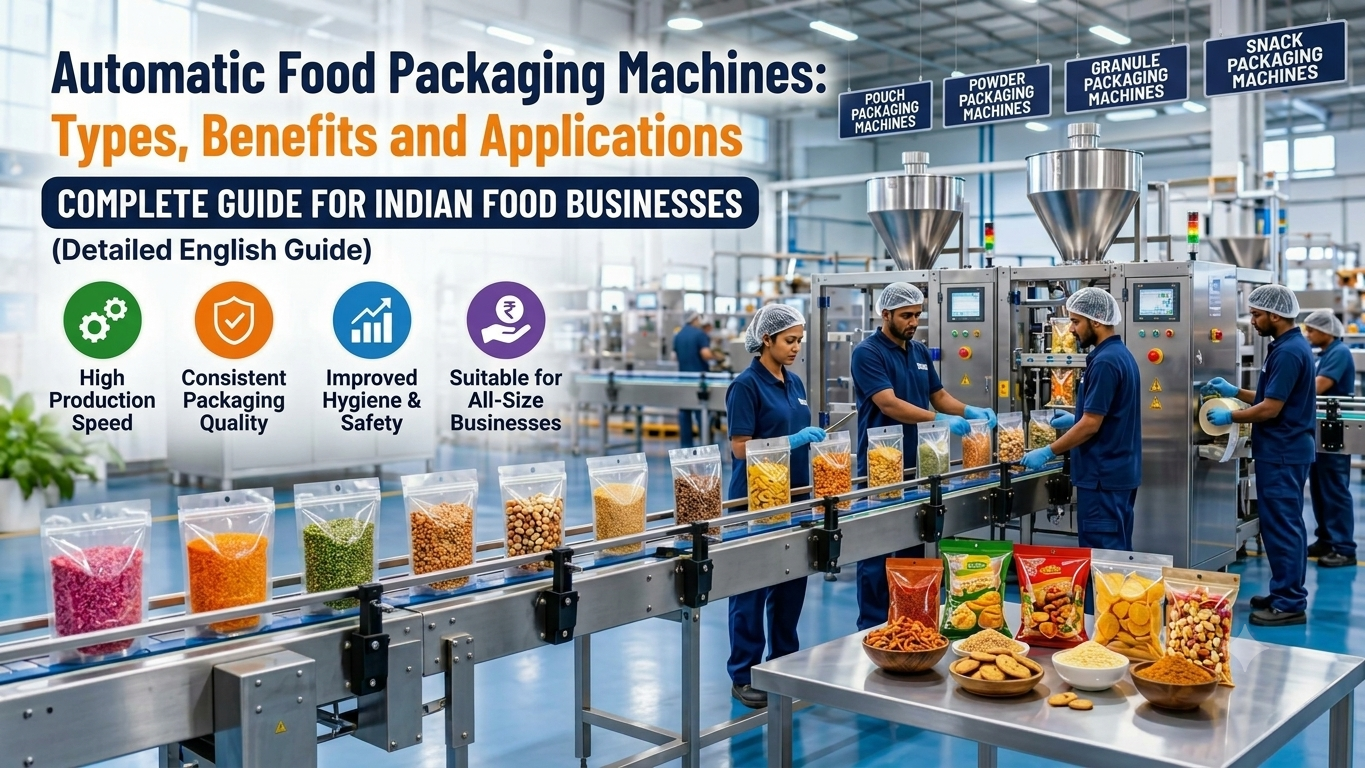
Pouch filling sealing machines are an important part of modern food packaging operations. They are designed to accurately fill products into pouches and seal them securely, helping food manufacturers improve packaging speed, accuracy, hygiene, and overall production efficiency.
From spices, flour, pulses, rice, and grains to snacks, dry fruits, powders, liquids, and other food products, pouch filling and sealing machines can be configured according to different product and packaging requirements.
What Is a Pouch Filling Sealing Machine?
A pouch filling sealing machine is an automated or semi-automated packaging machine that fills a specific quantity of product into a pouch and then seals it. Depending on the machine configuration, it can handle different pouch sizes, filling quantities, packaging materials, and product types.
These machines reduce the need for manual filling and sealing, making the packaging process faster and more consistent.
How Does a Pouch Filling Sealing Machine Work?
The working process generally includes several stages:
- Pouch Feeding or Formation: The machine positions a pre-made pouch or forms a pouch from packaging film.
- Product Filling: The required quantity of product is measured and filled into the pouch.
- Product-Level Control: The filling system helps maintain consistency in the quantity of product in each pack.
- Pouch Sealing: The filled pouch is sealed using a suitable sealing mechanism.
- Cutting and Discharge: Depending on the machine design, the finished pouch is separated and moved for further handling or secondary packaging.
Advanced machines may also include features such as date coding, nitrogen flushing, multi-lane operation, automatic pouch cutting, and other packaging functions.
Types of Products That Can Be Packed
Pouch filling sealing machines are suitable for a wide variety of food products. The appropriate filling system depends on the physical characteristics of the product.
Common applications include:
- Spices and masala
- Flour and atta
- Pulses and grains
- Rice
- Dry fruits
- Tea and coffee
- Namkeen and snacks
- Powdered food products
- Seeds
- Sugar and salt
- Sauces and ketchup
- Other liquid and semi-liquid food products
Types of Filling Systems
Different products require different filling mechanisms. Common filling systems include:
Volumetric Filling
Volumetric filling systems measure products based on volume and are commonly used for suitable granular and free-flowing products.
Auger Filling
Auger fillers are commonly used for powders and fine products. They help provide controlled and consistent filling for products such as spices, flour, and powdered ingredients.
Cup Filling
Cup fillers are suitable for many free-flowing granular products. The filling quantity can be adjusted according to the required pack size.
Liquid Filling
Liquid filling systems are designed for products such as sauces, ketchup, and other suitable liquid or semi-liquid food products.
Benefits of Pouch Filling Sealing Machines
Higher Production Speed
Automation can significantly increase packaging speed compared with manual filling and sealing, helping manufacturers handle larger production volumes.
Improved Filling Accuracy
A suitable filling system helps maintain consistent quantities in individual pouches and can reduce product wastage.
Better Packaging Quality
Automatic sealing provides more consistent and uniform seals, improving the overall appearance and reliability of finished packages.
Reduced Manual Labour
Automating filling and sealing operations can reduce repetitive manual work and allow operators to focus on machine monitoring and other production activities.
Improved Hygiene
Reduced manual handling can help maintain better hygiene during the packaging process, which is particularly important for food products.
Flexible Packaging Options
Depending on the machine model, manufacturers can use different pouch sizes, packaging materials, and filling quantities to meet their product requirements.
Applications in the Food Packaging Industry
Pouch filling sealing machines are widely used by food manufacturers, processors, FMCG companies, and other packaging businesses.
They can be used for packaging products such as spices, flour, rice, pulses, snacks, dry fruits, tea, seeds, powders, liquids, and other food products.
The machine configuration should be selected according to the product characteristics, required pack weight, pouch format, production capacity, and packaging material.
How to Choose the Right Pouch Filling Sealing Machine?
Before purchasing a pouch filling sealing machine, food manufacturers should consider several important factors:
Product Type
Identify whether the product is powder, granule, solid, liquid, or semi-liquid. This helps determine the appropriate filling mechanism.
Filling Quantity
The required pouch weight or volume should be considered when selecting the filling system and machine configuration.
Production Capacity
Manufacturers should select a machine based on their required packs per minute and overall production volume.
Pouch Size
The machine should support the required pouch dimensions and packaging format.
Packaging Material
The type and thickness of packaging film or pre-made pouch should be compatible with the machine’s sealing system.
Automation Level
Businesses can choose between semi-automatic and fully automatic solutions depending on production requirements, available labour, and desired level of automation.
Maintenance and Support
Easy maintenance, availability of spare parts, operator training, and after-sales support are also important factors when selecting packaging machinery.
Why Food Manufacturers Should Automate Pouch Packaging
As food production volumes increase, manual packaging can become time-consuming and difficult to maintain consistently. Pouch filling sealing machines help manufacturers streamline the packaging process while improving speed, filling consistency, sealing quality, and operational efficiency.
Automation can also help businesses maintain standardized packaging across large production batches and reduce dependency on repetitive manual operations.
Conclusion
A pouch filling sealing machine can be a valuable investment for food manufacturers looking to modernize their packaging operations. By combining accurate filling with reliable sealing, these machines help improve production efficiency, packaging consistency, hygiene, and product presentation.
The right machine should always be selected according to the product type, filling quantity, pouch size, packaging material, production capacity, and level of automation required. With the right packaging solution, food manufacturers can build a faster, more consistent, and efficient packaging process.