
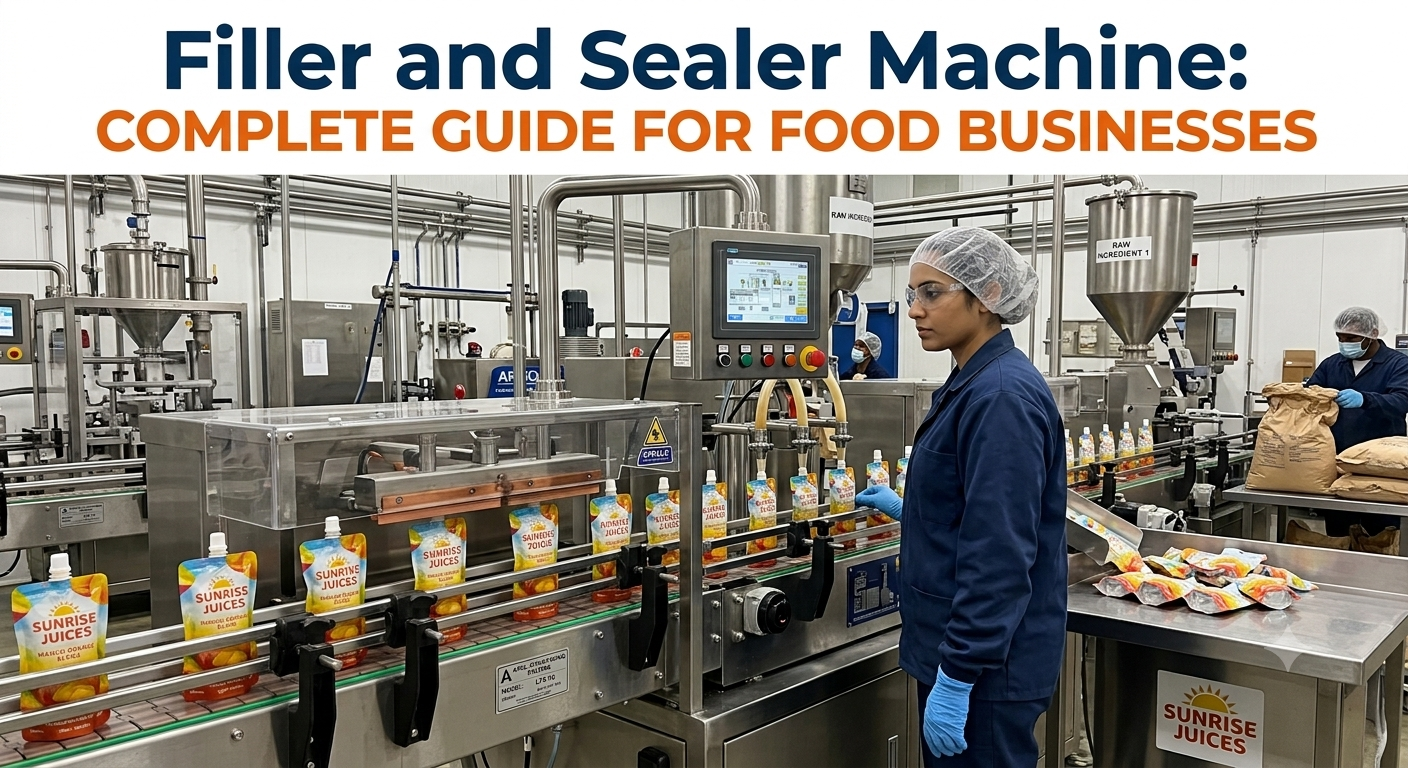
In the food packaging industry, accurate filling and reliable sealing are essential for maintaining product quality, hygiene, and consistency. A filler and sealer machine combines these two important packaging operations into an efficient system that can help food businesses improve production speed and reduce manual effort.
These machines are suitable for packaging a wide range of food products, including pulses, grains, rice, flour, spices, snacks, dry fruits, and other FMCG products. Depending on the product type, filling system, pouch size, and production requirements, different machine configurations can be used.
What Is a Filler and Sealer Machine?
A filler and sealer machine is packaging equipment designed to fill a predetermined quantity of product into a pouch or container and then seal it securely.
Instead of carrying out filling and sealing manually, the machine automates both operations. This helps manufacturers achieve more consistent pack weights and uniform sealing while increasing overall packaging efficiency.
A typical system may include:
- Product feeding system
- Measuring or weighing system
- Pouch or container positioning
- Filling mechanism
- Sealing unit
- Cutting or pouch separation system
- Finished product discharge
How Does a Filler and Sealer Machine Work?
The basic working process involves several automated steps:
1. Product Feeding
The product is supplied to the machine through a hopper, conveyor, or feeding system.
2. Accurate Measuring
The required quantity of product is measured using an appropriate weighing or dosing mechanism.
3. Filling
The measured product is transferred into the pouch or container.
4. Sealing
Once the product has been filled, the packaging is sealed using the machine’s sealing system.
5. Cutting or Separation
For pouch packaging, the sealed film can be cut according to the required pouch size.
6. Product Discharge
The completed package is discharged from the machine and can move to secondary packaging or storage.
Products That Can Be Packed
Filler and sealer machines can be used for a variety of food products, including:
- Pulses
- Rice
- Grains
- Flour and atta
- Spices
- Sugar
- Salt
- Seeds
- Dry fruits
- Snacks
- Namkeen
- Pet food
- Other dry and granular food products
The appropriate filling system should be selected according to the characteristics of the product.
Benefits of Filler and Sealer Machines
1. Accurate Product Filling
Automated weighing and dosing systems help maintain consistent quantities in every pack.
2. Faster Production
Automated filling and sealing can significantly improve packaging speed compared with manual operations.
3. Consistent Sealing
The machine provides uniform sealing across batches, helping create secure and professional packages.
4. Reduced Labour Requirements
Automation reduces the amount of repetitive manual work involved in filling and sealing.
5. Improved Hygiene
Reduced manual product handling can support better hygiene during the packaging process.
6. Reduced Product and Packaging Waste
Accurate filling and controlled sealing can help minimize product spillage and unnecessary packaging material usage.
7. Better Product Presentation
Uniformly filled and sealed packages provide a professional appearance suitable for retail distribution.
Applications in the Food Industry
Filler and sealer machines are useful for:
- Food processing units
- Rice and grain packaging
- Pulses packaging
- Flour mills
- Spice manufacturers
- Snack manufacturers
- FMCG businesses
- Dry fruit packaging
- Agricultural product packaging
- Retail food packaging
How to Choose the Right Filler and Sealer Machine?
Before purchasing a filler and sealer machine, food businesses should consider several factors:
Product Type:
Different products require different filling mechanisms. Free-flowing grains may require a different system than powdery products such as flour or spices.
Filling Capacity:
Determine the required pack weight and production capacity before selecting the machine.
Packaging Format:
Consider whether the business requires pouches, bags, containers, or another packaging format.
Production Speed:
Choose a machine capable of meeting the required output without compromising filling accuracy or sealing quality.
Packaging Material:
The machine should be compatible with the packaging film or material being used.
Automation Level:
Businesses can select a suitable level of automation depending on production volume, workforce, and budget.
Maintenance and Support:
Reliable technical support, spare parts availability, and easy maintenance are important for long-term machine performance.
Manual vs Automatic Filling and Sealing
Manual filling and sealing can be suitable for very small-scale operations, but it can become slow and inconsistent as production increases.
Automatic systems can perform filling and sealing continuously with less manual intervention. They are therefore particularly useful for medium- and large-scale food businesses that need higher production capacity and consistent packaging quality.
Why Invest in a Filler and Sealer Machine?
For a growing food business, packaging is an important part of the production process. A reliable filler and sealer machine can help reduce repetitive labour, improve filling consistency, increase production efficiency, and provide better-quality finished packages.
By integrating filling and sealing into one streamlined operation, businesses can create a more efficient packaging workflow and handle larger production volumes.
Conclusion
A filler and sealer machine is an important packaging solution for food businesses looking to improve filling accuracy, sealing quality, hygiene, and production efficiency. From pulses and grains to rice, flour, spices, snacks, and other FMCG products, these machines can be adapted to a wide range of packaging applications.