
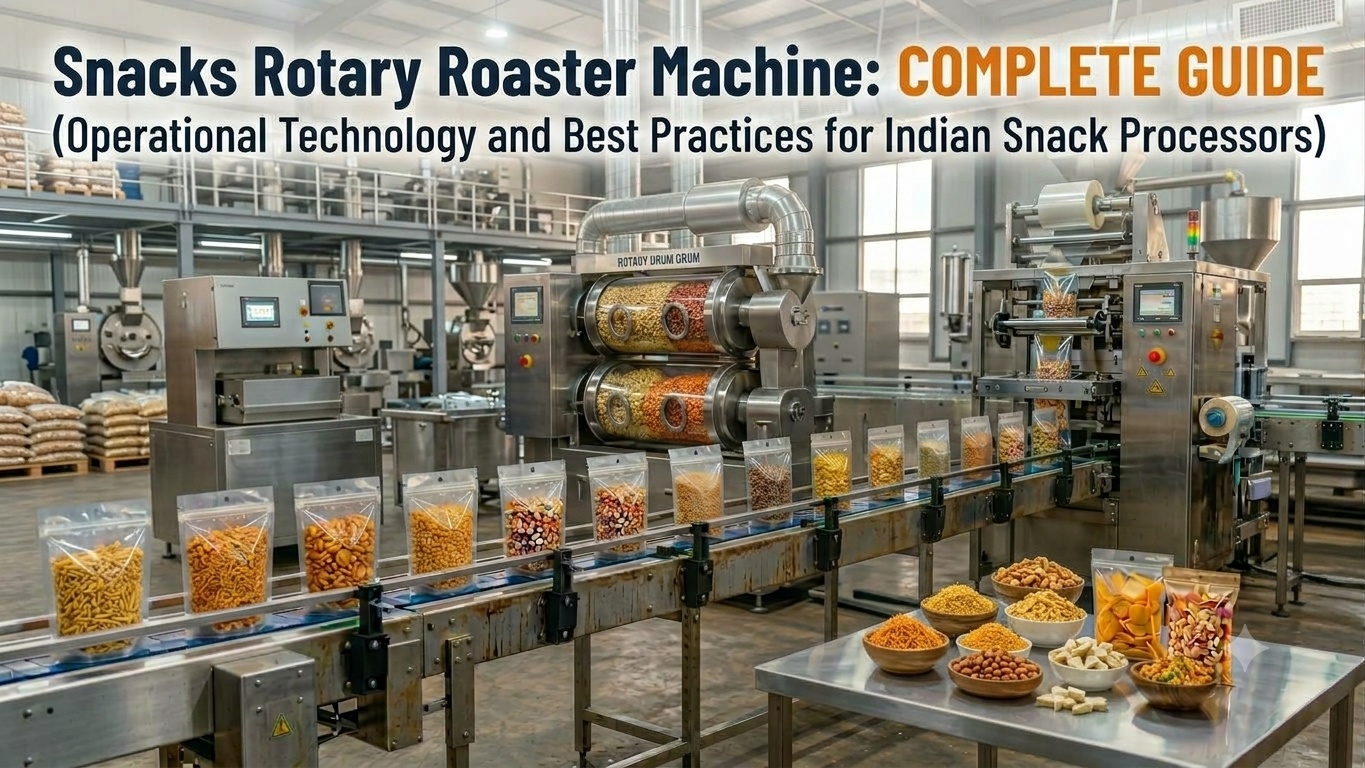
Roasting is an important process in the preparation of many snacks and food products. A snacks rotary roaster machine helps food manufacturers achieve consistent roasting by continuously rotating the product while applying controlled heat.
Rotary roasters can be used for different products such as peanuts, nuts, seeds, pulses, grains, and other suitable snack ingredients. By automating the roasting process, manufacturers can improve production efficiency, maintain consistent roasting, and reduce repetitive manual work.
What Is a Snacks Rotary Roaster Machine?
A snacks rotary roaster machine is food processing equipment designed to roast products evenly through controlled heating and continuous rotation. The rotating mechanism helps expose the product more uniformly to heat, supporting consistent roasting throughout the batch.
Depending on the machine design, fuel or electric heating systems may be used, along with temperature and roasting controls suitable for the application.
How Does a Rotary Roaster Machine Work?
The basic working process of a rotary roaster generally includes the following steps:
1. Product Feeding
The required quantity of raw material is loaded into the roasting chamber or feeding system.
2. Heating
The roasting chamber is heated to the required operating temperature according to the product and roasting requirements.
3. Continuous Rotation
The product moves continuously as the roasting drum rotates. This helps distribute heat more evenly and reduces the chances of uneven roasting.
4. Controlled Roasting
The roasting time and temperature are controlled according to the type of product and desired roasting result.
5. Cooling
After roasting, the product can be transferred to a cooling system or allowed to cool before seasoning, processing, or packaging.
Products Suitable for Rotary Roasting
Rotary roaster machines can be used for a variety of food and snack products, including:
- Peanuts
- Groundnuts
- Almonds
- Cashews
- Seeds
- Pulses
- Chickpeas
- Grains
- Corn-based products
- Other suitable snack ingredients
The exact product compatibility depends on the machine configuration, roasting temperature, moisture content, product size, and desired final characteristics.
Benefits of a Snacks Rotary Roaster Machine
Uniform Roasting
Continuous product rotation helps provide more consistent exposure to heat, supporting uniform roasting across the batch.
Improved Production Efficiency
A rotary roasting machine can handle continuous or batch-based production depending on its configuration, helping manufacturers process larger quantities efficiently.
Better Process Control
Controlled temperature and roasting time allow manufacturers to adjust the process according to different product requirements.
Reduced Manual Work
Automation reduces the need for repetitive manual stirring or handling during roasting.
Consistent Product Quality
Maintaining controlled roasting conditions can help manufacturers achieve more consistent taste, texture, colour, and overall product quality.
Versatile Applications
Rotary roasters can be used for different nuts, seeds, pulses, grains, and snack ingredients, depending on the machine specifications.
Applications in the Snack and Food Industry
Rotary roaster machines are commonly used in food processing operations where roasting is required before further processing or packaging.
They can be suitable for:
- Namkeen manufacturing
- Roasted peanut production
- Dry fruit processing
- Seed processing
- Pulse processing
- Snack manufacturing
- Cereal and grain processing
- Food ingredient preparation
After roasting, the products may be seasoned, cooled, weighed, and packed using suitable food packaging machinery.
Important Features to Consider
When selecting a snacks rotary roaster machine, manufacturers should evaluate features such as:
Temperature Control
Accurate temperature control helps maintain suitable roasting conditions for different products.
Adjustable Roasting Time
Different products may require different roasting durations. Adjustable controls provide greater flexibility.
Rotary Drum Design
The design and rotation mechanism should support proper product movement and uniform heat exposure.
Capacity
The machine should have sufficient capacity to meet the required production volume.
Food-Grade Construction
Suitable food-grade materials and hygienic construction are important for food processing applications.
Easy Cleaning and Maintenance
A machine that is easy to clean and maintain can help reduce downtime and support hygienic production.
How to Choose the Right Rotary Roaster Machine?
Before purchasing a rotary roaster, food manufacturers should consider the following factors:
Product Type: Identify the exact product that needs to be roasted.
Production Capacity: Determine the required output per hour or per batch.
Heating Method: Select a suitable heating system according to the production setup and product requirements.
Temperature Range: Check whether the machine provides the required temperature control.
Roasting Time: Ensure that the machine can accommodate the required roasting duration.
Automation Level: Choose between manual, semi-automatic, or automatic operation according to production needs.
Machine Construction: Consider durable and food-suitable materials for long-term operation.
After-Sales Support: Availability of spare parts, installation, maintenance, and technical support should also be considered.
Rotary Roaster for Namkeen Production
Roasting equipment can play an important role in namkeen and snack manufacturing. Products such as peanuts, pulses, and other ingredients may require roasting before seasoning or further processing.
A suitable rotary roaster can help maintain consistent roasting conditions and improve the efficiency of the overall production process. Once roasting is complete, the product can move to seasoning, cooling, and packaging stages.
Why Invest in a Rotary Roaster Machine?
For growing food businesses, manual roasting can become difficult to manage when production volumes increase. A rotary roaster provides a more controlled and efficient way to process suitable snack ingredients.
By reducing manual intervention and providing consistent heating and rotation, the machine can help manufacturers improve production efficiency and maintain more uniform product quality.
Conclusion
A snacks rotary roaster machine is an efficient food processing solution for roasting peanuts, nuts, seeds, pulses, grains, and other suitable products. Its rotating mechanism and controlled heating system help manufacturers achieve consistent roasting while reducing manual processing.
When choosing a rotary roaster, manufacturers should consider product type, capacity, heating system, temperature control, roasting time, construction quality, maintenance, and after-sales support. Selecting the right machine according to production requirements can help create a more efficient and consistent food processing operation.