
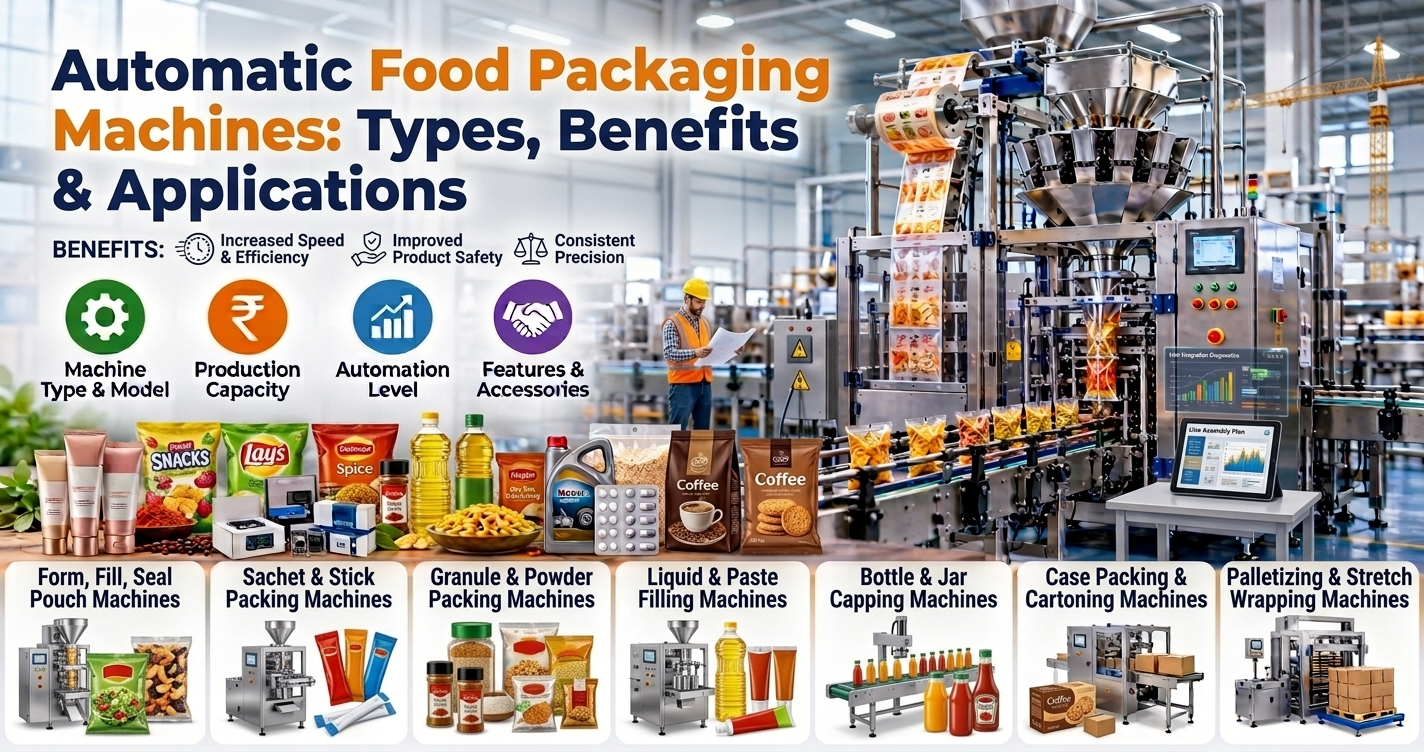
The food industry requires fast, accurate and hygienic packaging solutions to meet increasing production demands. Automatic food packaging machines have become an important part of modern food manufacturing because they can reduce manual work, improve packaging consistency and increase overall production efficiency.
From spices and pulses to snacks, grains, flour and dry fruits, automatic packaging machines are available for different food products and packaging requirements.
What Are Automatic Food Packaging Machines?
Automatic food packaging machines are advanced systems designed to perform packaging operations with minimal manual intervention. Depending on the machine type, they can automatically weigh, fill, form, seal, code and discharge packaged products.
These machines are commonly integrated with conveyors, weighing systems, filling systems and other packaging equipment to create a complete automated production line.
Types of Automatic Food Packaging Machines
Different food products require different packaging technologies. Some of the most common types include:
1. Automatic Weighing and Filling Machines
These machines accurately measure food products according to the required pack weight and transfer them into pouches, bags or containers.
They are commonly used for:
- Pulses
- Rice
- Grains
- Seeds
- Dry fruits
- Snacks
- Granular food products
Accurate weighing helps maintain consistent pack quantities and reduce product wastage.
2. Automatic Pouch Packing Machines
Automatic pouch packing machines can perform multiple packaging operations, such as pouch forming, product filling and sealing.
They are suitable for different types of food products and can be configured according to required pouch sizes and packaging materials.
3. Automatic Powder Packing Machines
Powder products require specialised filling systems because their flow characteristics are different from granular products.
These machines are commonly used for:
- Spices
- Masala
- Flour
- Turmeric
- Chilli powder
- Other powdered food products
Accurate filling helps maintain consistent product weight and packaging quality.
4. Automatic Sealing Machines
Sealing machines close food packages securely after filling. Proper sealing helps protect products from moisture, dust and external contamination.
Depending on the packaging format, different sealing technologies can be used for pouches, bags and other packaging materials.
5. Automatic Liquid Filling Machines
Liquid food products require suitable filling systems to maintain accurate quantities and minimise spillage.
These machines can be used for products such as sauces, oils, beverages and other liquid or semi-liquid food products.
6. Automatic Granule Packing Machines
Granular products need accurate and controlled feeding to achieve consistent pack weights.
Automatic granule packing machines are suitable for products such as grains, pulses, seeds, sugar, snacks and similar materials.
Benefits of Automatic Food Packaging Machines
Higher Production Speed
Automatic machines can package products continuously at a much higher speed than manual packaging processes. This makes them suitable for medium- and large-scale food production.
Improved Packaging Accuracy
Automatic weighing and filling systems provide better control over the quantity of product placed in every package.
Reduced Labour Requirements
Automation reduces repetitive manual activities such as weighing, filling and sealing. Operators can instead focus on machine monitoring and quality control.
Less Product Wastage
Accurate filling and controlled product handling can help reduce overfilling and unnecessary product loss.
Better Hygiene
Automatic packaging reduces excessive human contact with food products. This can help maintain cleaner and more hygienic packaging operations.
Consistent Packaging Quality
Machines provide consistent filling, sealing and packaging results across large production volumes.
Improved Productivity
By combining multiple packaging operations into an automated process, manufacturers can increase overall production efficiency.
Applications of Automatic Food Packaging Machines
Automatic food packaging machines are used across many areas of the food industry.
Spices and Masala
Powder packing systems can accurately fill and seal spices, masala and other powdered products.
Pulses and Grains
Weighing and filling machines are widely used for packaging rice, pulses, wheat, grains and similar products.
Snacks and Namkeen
Automatic packing systems can help food manufacturers package snacks and namkeen quickly while maintaining consistent pack weights.
Dry Fruits and Seeds
Accurate weighing systems are useful for packaging almonds, cashews, raisins, seeds and other dry products.
Flour and Powder Products
Specialised powder filling machines are suitable for flour, turmeric, chilli powder and other fine or free-flowing powders.
Sugar and Salt
Automatic packaging systems can be configured for accurate weighing and packing of products such as sugar and salt.
Automatic vs Manual Food Packaging
Manual packaging requires workers to perform activities such as weighing, filling and sealing. While it may be suitable for small production volumes, it can become difficult to maintain speed and consistency as production increases.
Automatic packaging machines reduce repetitive manual operations and provide greater control over production speed, filling accuracy and packaging consistency.
For businesses with increasing production requirements, automation can provide a more scalable packaging solution.
Factors to Consider Before Buying an Automatic Packaging Machine
Before selecting a machine, food manufacturers should evaluate several factors:
Product Type
Determine whether the product is powder, granule, liquid, solid or a combination of different materials.
Pack Size
Consider the required packaging sizes and whether the machine can support multiple pack sizes.
Production Capacity
Select machinery according to the required packets per minute or total production volume.
Packaging Material
Check whether the machine is compatible with the packaging material and pouch format being used.
Automation Level
Choose the appropriate level of automation based on production requirements, labour availability and budget.
Machine Quality
Look for durable construction, reliable components and suitable food-contact materials.
Maintenance and Service
Availability of spare parts, technical support and after-sales service should also be considered before purchasing.
How Automatic Packaging Machines Improve Food Production
Automatic packaging machines can improve the overall production process by connecting different packaging operations into a streamlined workflow.
A typical automated process may include:
Product Feeding → Weighing/Filling → Pouch Formation → Sealing → Coding → Inspection → Final Collection
This reduces unnecessary manual handling and helps maintain a consistent production flow.
Why Choose the Right Packaging Machinery Manufacturer?
The performance of an automatic packaging machine depends not only on its design but also on installation, configuration and after-sales support.
A reliable packaging machinery manufacturer can help businesses with:
- Machine selection
- Product testing
- Customisation
- Installation
- Operator training
- Maintenance support
- Spare parts
- Technical assistance
Choosing the right manufacturer can help ensure that the machine matches the product and production requirements.
Conclusion
Automatic food packaging machines provide an efficient solution for modern food manufacturers looking to improve production speed, packaging accuracy, hygiene and consistency. From spices and powders to pulses, grains, snacks and dry fruits, different automatic machines are available for a wide range of food products.
Before investing in a machine, manufacturers should carefully evaluate product type, pack size, production capacity, packaging material, automation level, maintenance and after-sales support.
With the right automatic food packaging machine and a properly planned production line, businesses can improve operational efficiency and build a more reliable and scalable packaging process.