
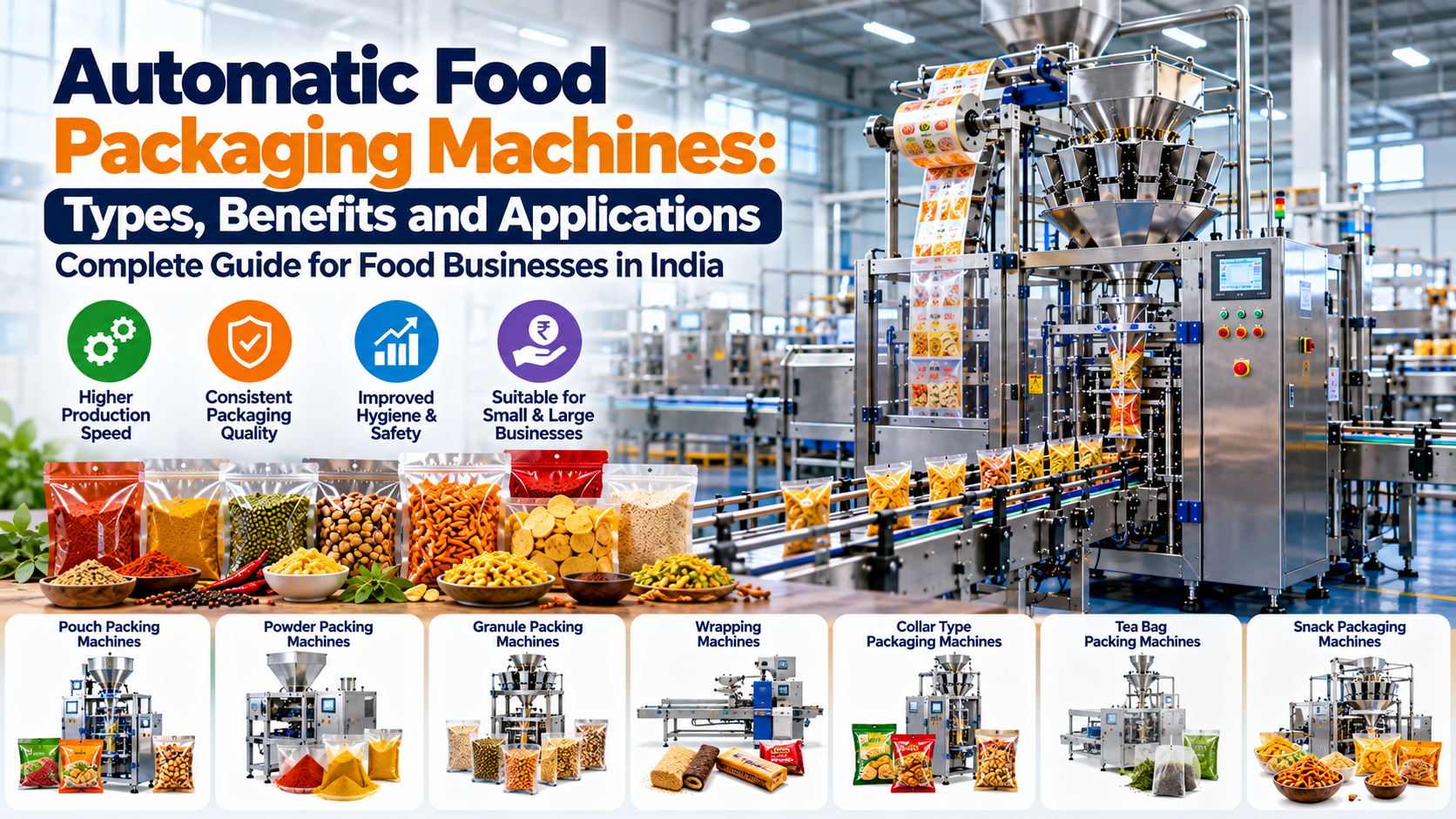
Starting a food business is easier than ever, but maintaining consistent product quality, packaging and production efficiency becomes increasingly important as orders grow. For small food manufacturers, choosing the right food packaging machine can reduce repetitive manual work, improve packaging consistency and help prepare the business for higher production volumes.
From spices and powders to namkeen, snacks, grains and other packaged foods, different products require different packaging technologies.
In this guide, we explain the best food packaging machines for small businesses in India, their applications, benefits, selection factors and what businesses should consider before investing in packaging machinery.
Why Small Food Businesses Need Packaging Machines
Many small food businesses initially depend on manual weighing, filling and sealing. This may work when production is limited, but manual packaging can become difficult as demand increases.
A suitable packaging machine can help with:
- Faster packaging operations
- More consistent filling
- Better sealing consistency
- Reduced repetitive manual work
- Improved production organization
- More professional product presentation
- Easier scaling as demand grows
The right machine depends on the product, package size, packaging material and expected production volume.
Best Food Packaging Machines for Small Businesses
There is no single machine that is best for every food business. The ideal solution depends on what you manufacture.
Here are some of the most useful packaging machine categories for small and growing food manufacturers.
1. Pouch Packing Machine
A pouch packing machine is one of the most versatile options for businesses selling packaged food products.
Depending on the machine configuration, pouch packing systems can be used for products such as:
- Spices
- Masala
- Namkeen
- Snacks
- Grains
- Pulses
- Seeds
- Dry food products
A pouch packing system can combine product filling and pouch sealing into a streamlined packaging process.
Who Should Consider It?
Pouch packing machines can be useful for:
- Spice manufacturers
- Namkeen businesses
- Snack manufacturers
- Grain and pulse businesses
- Food startups
- FMCG businesses
2. Powder Packing Machine
Businesses producing powdered food products need a filling system designed for powder handling.
Typical applications include:
- Turmeric powder
- Chilli powder
- Coriander powder
- Garam masala
- Spice blends
- Flour
- Other powdered food ingredients
The filling mechanism should be selected according to the powder’s characteristics, including flowability, density and particle size.
Why Use a Powder Packing Machine?
A suitable powder packaging machine can help businesses achieve more consistent filling and simplify the repetitive packaging process.
For growing spice businesses, this can be particularly useful when moving from small-batch manual packing toward more organized production.
3. Filling and Sealing Machine
A filling and sealing machine combines two important packaging operations.
The general process is:
Product → Filling → Packaging → Sealing → Finished Pack
Instead of manually filling a package and then sealing it separately, an integrated system can streamline these operations.
Suitable Applications
Depending on the machine configuration, filling and sealing systems may be used for:
- Food powders
- Granules
- Snacks
- Dry food products
- Other suitable packaged products
4. Wrapping Machine
Wrapping machines are useful when the product requires an outer wrapping rather than a traditional pouch format.
Potential applications include:
- Bakery products
- Biscuits
- Snacks
- Confectionery
- Food bars
- Other individually packaged products
For businesses producing retail-ready products, automated wrapping can provide a consistent packaging format.
5. Collar-Type Packaging Machine
A collar-type packaging machine is commonly used in vertical packaging applications.
The packaging film is formed around the product, followed by filling and sealing.
This type of packaging system can be suitable for businesses looking for flexible pouch packaging for food products.
Possible Applications
- Spices
- Granules
- Snacks
- Dry food products
- Namkeen
- Other suitable products
The correct configuration depends on product characteristics, pack size and production requirements.
6. Tea Bag Packing Machine
Tea manufacturers have specialized packaging requirements.
A tea bag packing machine can automate important stages of tea bag production and packaging, depending on the machine configuration.
This can be useful for:
- Tea manufacturers
- Private-label tea businesses
- Specialty tea brands
- Small and medium tea-processing businesses
Businesses should select equipment based on the desired tea bag format, production capacity and packaging requirements.
7. Snack Packaging Machines
Snack manufacturers often need packaging solutions capable of handling products with different shapes, sizes and textures.
Common products include:
- Namkeen
- Puffed snacks
- Corn snacks
- Extruded snacks
- Potato chips
- Fried snacks
Snack packaging systems can be combined with weighing, conveying and filling equipment to create a more efficient production workflow.
8. Potato Chips Packaging Machinery
Businesses producing potato chips may require several machines across the production process.
A typical workflow can include:
Potato → Peeling → Slicing → Processing → Frying → Seasoning → Weighing → Packaging → Sealing
Not every small business needs a fully automated line. Machinery can be selected according to production volume and gradually expanded as the business grows.
How to Choose a Food Packaging Machine for Your Small Business
Before purchasing a packaging machine, consider the following factors.
1. Identify Your Product
Start with the most important question:
What product are you packaging?
Powders, granules, snacks, tea, bakery products and other foods may require different packaging mechanisms.
Do not select machinery based only on the appearance or advertised speed of the machine.
2. Determine Your Pack Size
Decide which pack sizes you plan to sell.
For example:
- 50 g
- 100 g
- 200 g
- 250 g
- 500 g
- 1 kg
The machine should support the required packaging range or be configurable for the sizes your business needs.
3. Estimate Production Requirements
Calculate approximately how many packets you need to produce per hour and per day.
For example:
Current requirement: 500 packets/day
Expected future requirement: 2,000 packets/day
Choosing equipment only for today’s production may create limitations when the business expands.
4. Consider Automation Level
Small businesses generally have several automation options.
Manual
The operator performs most packaging operations.
Semi-Automatic
Some processes are automated while the operator performs other tasks.
Automatic
Multiple packaging operations are integrated into an automated workflow.
The right choice depends on production volume, available budget, labour requirements and future growth.
Semi-Automatic vs Automatic Packaging Machines
| Feature | Semi-Automatic | Automatic |
|---|---|---|
| Initial Investment | Generally lower | Generally higher |
| Manual Intervention | Higher | Lower |
| Production Volume | Small to medium | Medium to high |
| Automation | Partial | Higher |
| Operator Involvement | More | Less |
| Scalability | Suitable for growing businesses | Suitable for higher-volume production |
There is no universal winner between the two. A small business should choose the automation level that matches its actual production requirements.
Food Packaging Machine Price in India
The price of a food packaging machine varies depending on its design and configuration.
Important factors include:
Machine Type
A powder packing machine, wrapping machine, pouch machine and specialized tea packaging machine can have different price ranges.
Automation
Automatic systems generally involve more components and controls than simpler manual or semi-automatic equipment.
Production Capacity
Higher-capacity machinery may require more advanced mechanical, electrical and control systems.
Product Characteristics
Powders, granules, snacks and other products require different filling technologies.
Pack Size
The required range of pack sizes can affect machine configuration.
Customization
Special packaging requirements can influence the final machine specification and cost.
Additional Equipment
The overall project may include:
- Conveyors
- Weighing systems
- Elevators
- Coding systems
- Feeding systems
- Inspection equipment
For these reasons, businesses should request a quotation based on their actual product and production requirements instead of comparing machines only by price.
Benefits of Investing in Packaging Machinery
Improved Packaging Consistency
Automated filling and sealing can help standardize repetitive packaging operations when properly configured and maintained.
Faster Production
Machines can process packaging tasks more efficiently than manual operations, depending on the machine and product.
Reduced Repetitive Work
Automation can reduce repetitive manual filling, weighing and sealing tasks.
Better Product Presentation
Consistent packaging can provide a more professional appearance across a product range.
Easier Business Expansion
Packaging automation can help a growing business handle increasing production requirements.
Packaging Machines for Different Food Businesses
Different businesses have different requirements.
| Business Type | Potential Packaging Solution |
|---|---|
| Spice Manufacturer | Powder Packing Machine |
| Namkeen Manufacturer | Pouch Packing Machine |
| Snack Manufacturer | Weighing + Pouch Packing |
| Grain Business | Granule Packing Machine |
| Tea Manufacturer | Tea Bag Packing Machine |
| Bakery Business | Wrapping Machine |
| Potato Chips Business | Chips Processing + Packaging |
| FMCG Manufacturer | Automated Packaging Line |
The exact machine should be selected after evaluating the product and production requirements.
How Small Businesses Can Start With Packaging Automation
A small business does not necessarily need to purchase an entire automated production line immediately.
A practical approach is to identify the biggest production bottleneck.
For example:
Spice Business
Grinding → Powder → Filling → Sealing
If manual filling is the bottleneck, start by automating the filling and packaging stage.
Namkeen Business
Production → Weighing → Filling → Sealing
If weighing and packing are taking too much time, focus on the weighing and packaging system.
Potato Chips Business
Potato Processing → Slicing → Frying → Seasoning → Packaging
Automation can be introduced progressively as production increases.
This approach allows businesses to align their machinery investment with actual operational requirements.
Important Questions to Ask a Packaging Machine Manufacturer
Before purchasing machinery, ask the supplier:
- What products can the machine handle?
- What pack sizes are supported?
- What production capacity can be expected?
- What packaging materials are compatible?
- What electrical requirements are needed?
- What are the machine dimensions?
- Is installation support available?
- What spare parts are available?
- What maintenance is required?
- Can the machine be tested with our actual product?
- Can the machine be customized?
- What after-sales technical support is available?
A product trial using your actual food product and packaging material can be particularly useful before finalizing the equipment.
Common Mistakes Small Food Businesses Should Avoid
Choosing Only on Price
The cheapest machine may not necessarily provide the right functionality for your product.
Ignoring Future Growth
Consider how production may change over the next few years.
Not Testing the Product
Different powders, grains and snacks behave differently. Product testing can help verify machine suitability.
Ignoring Packaging Material
Make sure the machine is compatible with the packaging film and pouch format you plan to use.
Forgetting Maintenance
Consider cleaning, spare parts, servicing and technical support before making the purchase.
Why Choose Hind Food Packaging?
Hind Food Packaging provides food-processing and packaging machinery for different food manufacturing applications.
Its machinery portfolio includes solutions related to:
- Food packaging
- Pouch filling and sealing
- Wrapping
- Snack processing
- Potato processing
- Food extrusion
- Roasting
- Grinding
- Conveying
- Tea packaging
For a small or growing food business, the right machine should be selected according to the product, pack size, production volume, packaging material and desired automation level.
Final Thoughts
Choosing the best food packaging machine for a small business in India starts with understanding your product and production requirements.
A spice manufacturer may need a powder packing machine, while a namkeen manufacturer may require weighing and pouch packing equipment. A bakery business may benefit from wrapping machinery, while a tea manufacturer may require specialized tea bag packaging equipment.