
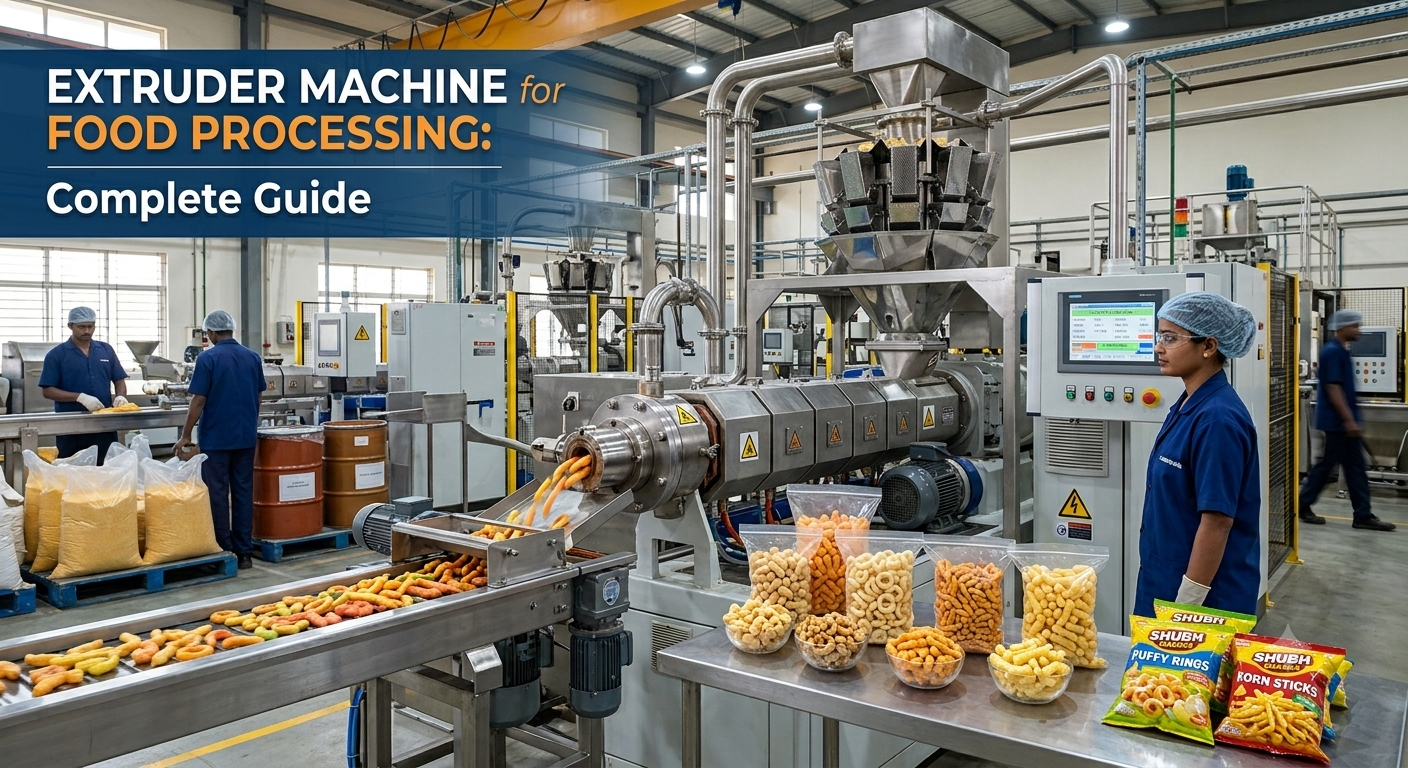
Food processing extruder machines are widely used in the food industry to process, shape, and produce a variety of food products. Extrusion technology helps manufacturers achieve consistent product shapes, textures, and production quality while supporting efficient and continuous processing.
Extruder machines can be used for different applications depending on the raw material, product formulation, required shape, production capacity, and processing conditions. They are commonly found in snack, cereal, pasta, pet food, and other food processing applications.
What Is a Food Processing Extruder Machine?
A food processing extruder is a machine that processes food ingredients through a controlled extrusion system to produce a desired shape, texture, or structure. The raw material is fed into the machine, where it undergoes controlled mixing, compression, and processing before being pushed through a specially designed die.
The die determines the shape and size of the extruded product. Depending on the machine and application, additional processes such as cutting, drying, frying, or seasoning may be carried out after extrusion.
How Does a Food Extruder Machine Work?
The basic working process of a food extruder generally includes the following stages:
1. Feeding
Prepared raw materials are introduced into the extruder through the feeding system. Consistent feeding helps maintain stable production.
2. Mixing and Processing
Inside the extruder, the ingredients are mixed and processed while moving through the machine. Temperature, pressure, moisture, and processing conditions may be controlled according to the product requirements.
3. Compression
The material is gradually compressed as it moves through the extrusion barrel. This helps create the required consistency and processing conditions.
4. Extrusion Through the Die
The processed material is pushed through a die that determines the shape and size of the final product.
5. Cutting
A cutting system can be used to divide the extruded product into the required length or size.
6. Further Processing
Depending on the product, the extruded material may undergo drying, frying, cooling, seasoning, or other processes before packaging.
Types of Food Extruder Machines
Different extruder designs are available for different food processing applications.
Single Screw Extruder
Single screw extruders use one rotating screw to transport and process the material. They can be suitable for various food processing applications depending on the formulation and product requirements.
Twin Screw Extruder
Twin screw extruders use two screws and provide greater flexibility in mixing and processing. They can be useful for products requiring better ingredient distribution and controlled processing.
Snack Food Extruder
Snack extruders are used to produce different types of extruded snacks in various shapes and sizes. They can be integrated with additional equipment for cutting, drying, frying, or seasoning.
Applications of Food Extruder Machines
Food processing extruders are used across several food manufacturing applications, including:
- Extruded snacks
- Breakfast cereals
- Pasta products
- Cereal-based products
- Namkeen and savoury snacks
- Protein-based food products
- Pet food
- Other processed food products
The exact application depends on the machine design, raw material, formulation, and required final product.
Benefits of Using an Extruder Machine
Consistent Product Shape
The use of customized dies allows manufacturers to produce products with consistent shapes and dimensions.
Improved Production Efficiency
Continuous extrusion processing can help manufacturers achieve higher production output compared with certain traditional processing methods.
Better Process Control
Modern extruders can provide control over important processing parameters such as temperature, pressure, feeding rate, and screw speed.
Product Variety
Different dies and machine configurations can allow manufacturers to produce multiple product shapes and formulations.
Reduced Manual Processing
Automated feeding, extrusion, and cutting systems can reduce repetitive manual operations.
Easy Integration
Extruders can be integrated with other food processing equipment, including conveyors, dryers, fryers, seasoning systems, and packaging machines.
Factors to Consider Before Buying a Food Extruder
Choosing the right extruder requires an understanding of your product and production requirements.
Product Type
Identify the food product you intend to manufacture and understand its raw material and formulation requirements.
Production Capacity
Select a machine according to the required output per hour or per day.
Screw Configuration
Single screw or twin screw technology should be selected according to the processing characteristics of the product.
Die Design
The die plays an important role in determining the final shape and dimensions of the extruded product.
Temperature and Process Control
For applications requiring controlled processing conditions, check the available temperature, pressure, and speed control systems.
Material and Construction
Food processing equipment should be manufactured using suitable food-grade materials and a hygienic design that allows convenient cleaning and maintenance.
Maintenance and Service
Availability of spare parts, technical support, installation, and after-sales service should also be considered when selecting an extruder machine.
Extruder Machine for Snack Food Production
Extrusion technology is particularly useful for snack manufacturing because it can produce products in different shapes, sizes, and textures. An extruder can be combined with cutting, frying or drying, seasoning, and packaging equipment to create a streamlined snack production line.
This type of setup can help manufacturers improve production consistency and handle larger quantities efficiently.
Why Choose the Right Extruder Machine?
Every food product has different processing requirements. Selecting an extruder based only on production capacity may not provide the desired results. Manufacturers should consider raw materials, moisture content, formulation, desired texture, product shape, output requirements, and downstream processing.
A properly selected extruder can improve process stability, product consistency, and overall production efficiency.
Conclusion
An extruder machine for food processing is a versatile solution for manufacturers producing snacks, cereals, pasta, and other processed food products. By combining controlled feeding, mixing, compression, extrusion, and cutting, the machine can help streamline production and maintain consistent product quality.
Before investing in an extruder, manufacturers should evaluate the product, required capacity, screw configuration, die requirements, process controls, construction quality, and after-sales support. Choosing the right machine can help build an efficient and reliable food processing production line.