
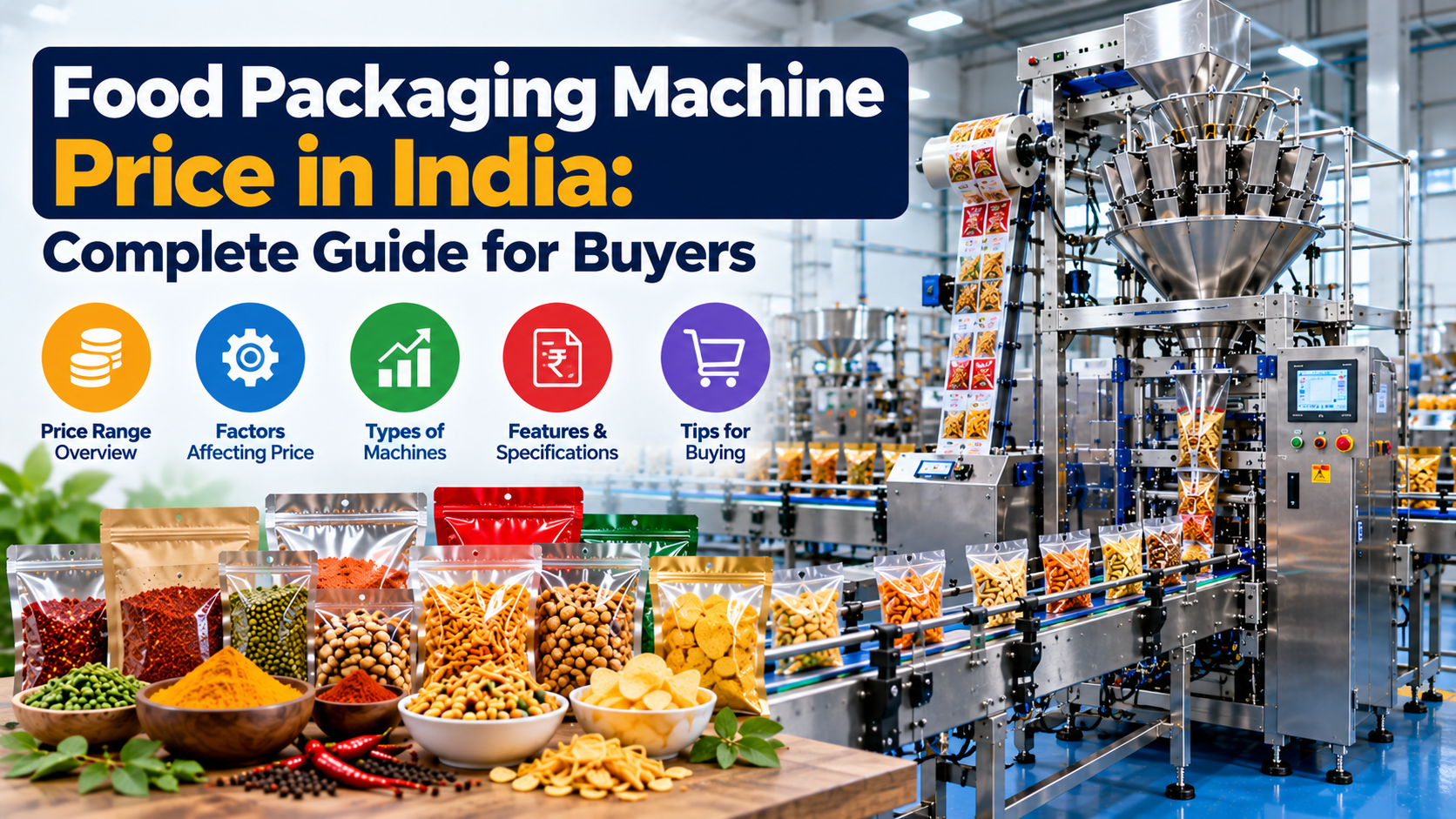
Food packaging machines have become an essential part of modern food processing and manufacturing businesses. They help companies improve production speed, maintain consistent packaging quality, reduce manual work, and minimize product wastage.
One of the first questions businesses ask before purchasing packaging equipment is: What is the food packaging machine price in India?
The answer is not the same for every machine. The price depends on several factors, including the type of machine, production capacity, automation level, product characteristics, packaging format, machine material, technology, and additional features.
This guide explains the major factors that affect the price of food packaging machines in India and what businesses should consider before making a purchase.
What Is a Food Packaging Machine?
A food packaging machine is equipment designed to automate one or more packaging processes such as weighing, filling, pouch formation, sealing, wrapping, conveying, and coding.
These machines are used for packaging products such as:
- Spices and masala
- Pulses and grains
- Rice
- Flour
- Snacks and namkeen
- Dry fruits
- Seeds
- Sugar and salt
- Powdered food products
- Granular products
- Other processed food items
Depending on the product and packaging requirement, businesses can select from different types of manual, semi-automatic, and fully automatic packaging machines.
Why Does Food Packaging Machine Price Vary in India?
There is no fixed price for every food packaging machine because every production setup has different requirements.
A small semi-automatic machine designed for limited production will have different specifications and costs compared with a fully automatic packaging line designed for continuous industrial production.
The following factors have a major impact on the overall machine price.
1. Type of Packaging Machine
The type of machine is one of the biggest factors affecting the purchase cost.
Different machines are designed for different packaging operations, such as:
- Weighing machines
- Filling machines
- Pouch packing machines
- Sealing machines
- Automatic packing machines
- Conveyor systems
- Multi-function packaging machines
- Complete automated packaging lines
A machine with more functions and advanced automation will generally require a higher investment than a basic machine.
2. Level of Automation
Automation has a significant impact on the cost of food packaging machinery.
Semi-Automatic Machines
Semi-automatic machines require some manual intervention during the packaging process. They can be suitable for small and medium-sized businesses that want to improve productivity without investing in a fully automated production line.
Fully Automatic Machines
Fully automatic machines perform multiple packaging operations with minimal manual intervention.
They are generally suitable for businesses with higher production volumes where speed, consistency, and labour reduction are important.
Therefore, the required automation level should be selected according to your actual production needs rather than choosing the most automated machine available.
3. Production Capacity
The required production capacity also affects the machine price.
A machine designed to handle a higher number of packs per minute may require more advanced components, stronger construction, faster feeding systems, and sophisticated controls.
Before purchasing, determine:
- Required packs per minute
- Daily production target
- Number of operating hours
- Expected future production
- Required filling accuracy
Choosing the right capacity can help avoid both under-utilization and unnecessary investment.
4. Product Type
Different food products behave differently during filling and packaging.
For example, powders, liquids, granules, grains, snacks, and irregular-shaped products may require different feeding and filling systems.
The machine may need customized components depending on:
- Product density
- Flow characteristics
- Particle size
- Moisture content
- Product shape
- Product sensitivity
Therefore, the product being packed can directly influence the final machine configuration and price.
5. Packaging Size and Format
The size and type of packaging also affect machine specifications.
Businesses may require different pack sizes such as small retail packs, medium packs, or larger bulk packs.
The machine may also need to support different packaging formats, including:
- Pouches
- Bags
- Containers
- Sachets
- Laminated packaging
- Other flexible packaging formats
A machine capable of handling multiple sizes and formats may require additional adjustments or components.
6. Machine Material and Build Quality
Food packaging equipment must be designed with hygiene, durability, and ease of cleaning in mind.
The material used for machine construction and product-contact parts can influence the overall cost.
For food processing applications, manufacturers may use suitable stainless-steel components in areas where hygiene and product contact are important.
A well-built machine can also provide better durability and reliability over long-term use.
7. Control System and Technology
Modern packaging machines may include advanced control systems, sensors, digital displays, programmable controls, and automated monitoring.
These technologies can improve:
- Filling accuracy
- Production consistency
- Machine control
- Error detection
- Operational efficiency
- User convenience
More advanced control and automation features can increase the initial investment but may provide operational benefits over the machine’s working life.
8. Customization Requirements
Not every production facility requires a standard machine.
A business may need customized machinery based on its product, packaging size, available space, production capacity, or existing equipment.
Customization can include:
- Customized filling range
- Special feeding systems
- Different pouch sizes
- Conveyor integration
- Additional sealing systems
- Automatic feeding
- Coding and printing systems
- Integration with existing production lines
The more customized the machine configuration, the more the overall cost can vary.
9. Additional Features and Accessories
Additional equipment can also affect the final price.
Depending on the application, businesses may require:
- Conveyors
- Coding machines
- Date and batch printing systems
- Product feeders
- Weighing systems
- Automatic feeding systems
- Inspection systems
- Additional sealing units
Instead of looking only at the base machine price, businesses should consider the complete setup required for their production process.
10. Installation and Training
The total investment may also include installation, commissioning, operator training, and technical support.
Proper installation and training help operators understand the machine and use it correctly.
Before purchasing, ask the manufacturer whether installation and training are included in the quoted price or charged separately.
11. Spare Parts and Maintenance
Maintenance is an important part of the long-term cost of packaging machinery.
Before buying a machine, check:
- Availability of spare parts
- Maintenance requirements
- Replacement component costs
- Service support
- Technical assistance
- Expected maintenance intervals
A machine with easily available spare parts and reliable service support can help reduce unnecessary production downtime.
How to Choose a Food Packaging Machine Within Your Budget?
Instead of selecting a machine based only on its initial price, consider the complete value it provides.
Start by defining your requirements:
Step 1: Identify Your Product
Determine whether you are packaging powder, granules, grains, snacks, spices, or another food product.
Step 2: Decide the Pack Size
Identify the required weight or volume for each package.
Step 3: Calculate Production Requirements
Estimate your required packs per minute and total daily production.
Step 4: Choose Automation Level
Decide whether manual, semi-automatic, or fully automatic machinery is suitable for your operation.
Step 5: Consider Future Growth
If you expect production to increase, choose a machine configuration that can support your future requirements.
Step 6: Compare Complete Machine Costs
Compare not only the machine purchase price but also installation, accessories, power requirements, maintenance, spare parts, and service support.
Initial Price vs. Long-Term Value
The lowest-priced machine may not always be the most economical choice.
A machine with better build quality, reliable components, accurate filling, efficient operation, and good after-sales support may provide greater value over the long term.
Businesses should therefore evaluate the total cost of ownership rather than comparing only the initial purchase price.
Questions to Ask Before Buying a Food Packaging Machine
Before finalizing your purchase, ask the manufacturer:
- What type of food products can the machine handle?
- What is the practical production capacity?
- What pack sizes are supported?
- What level of automation is available?
- Can the machine be customized?
- What material is used for product-contact parts?
- What is the power requirement?
- What installation support is provided?
- Is operator training included?
- What warranty is offered?
- Are spare parts easily available?
- What after-sales service is provided?
Getting clear answers to these questions can help you make a better purchasing decision.
Why Choose HIND Food Packaging?
HIND Food Packaging provides packaging machinery solutions designed for different food processing and packaging requirements.
We understand that every business has different production volumes, products, packaging formats, and operational requirements. Our approach focuses on identifying the appropriate machinery configuration according to the customer’s application.
Whether you are setting up a new food processing unit, upgrading existing equipment, or increasing production capacity, selecting the right packaging machinery can help improve efficiency and packaging consistency.
Final Thoughts
The food packaging machine price in India depends on several factors rather than a single fixed rate. Machine type, automation level, production capacity, product characteristics, packaging format, machine construction, customization, technology, and additional equipment can all influence the final investment.