
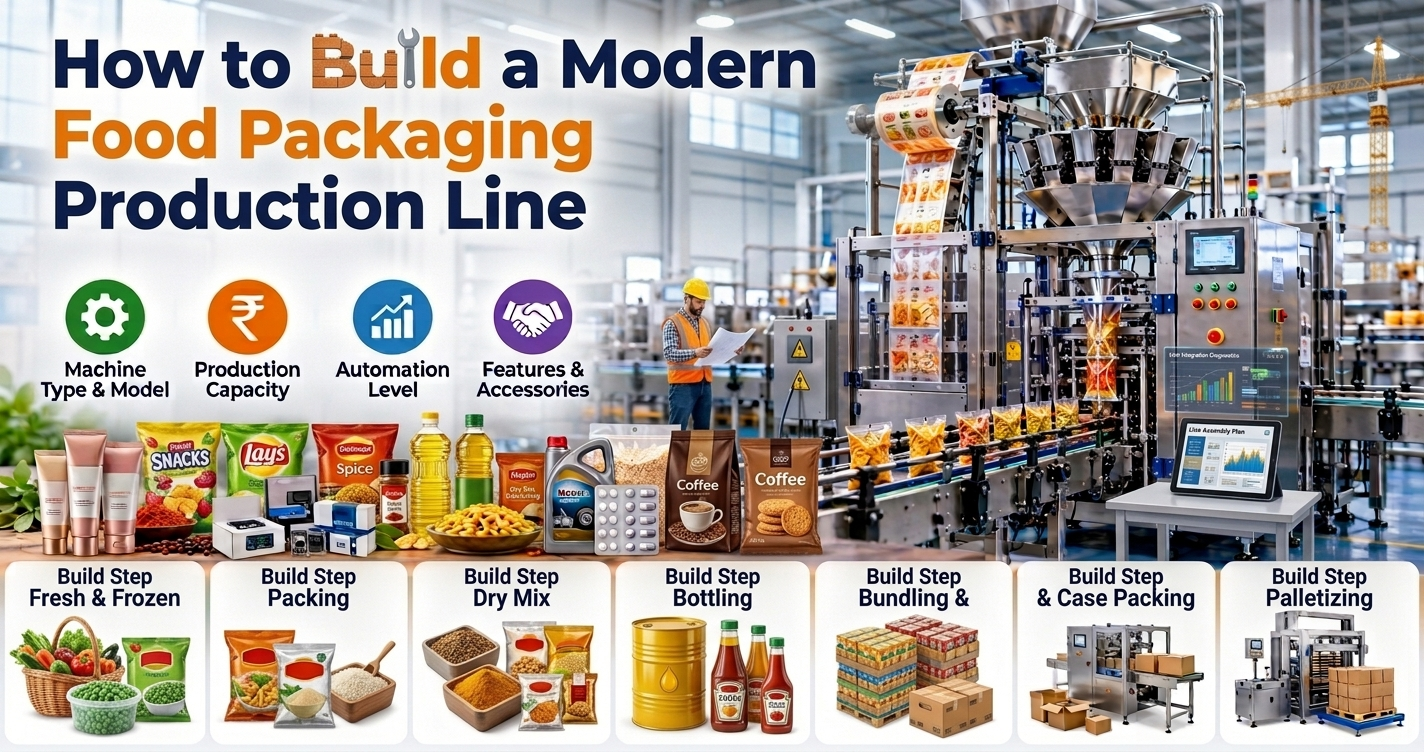
A modern food packaging production line helps food manufacturers improve production speed, packaging accuracy, product quality and overall operational efficiency. With increasing demand for hygienic, attractive and consistent packaging, businesses are moving from manual packaging processes to semi-automatic and fully automatic packaging systems.
Building the right production line requires careful planning. From selecting suitable packaging machines to deciding the production capacity, layout, automation level and quality-control process, every factor plays an important role.
What Is a Food Packaging Production Line?
A food packaging production line is a connected system of machines and processes used to weigh, fill, pack, seal, label and prepare food products for storage or distribution.
Depending on the product and production requirements, a packaging line may include:
- Product feeding systems
- Weighing or filling machines
- Pouch packing machines
- Sealing machines
- Conveyors
- Coding and printing systems
- Metal detection or inspection equipment
- Labelling machines
- Collection and packing systems
A properly designed line allows different stages of packaging to work together smoothly and reduces unnecessary manual handling.
Steps to Build a Modern Food Packaging Production Line
1. Identify Your Food Product
The first step is to understand the type of food product you want to package. Different products require different packaging technologies.
For example:
- Spices and masala require accurate powder filling.
- Pulses and grains require precise weighing and filling.
- Snacks and namkeen may require high-speed pouch packing.
- Flour and other powders need suitable filling systems.
- Dry fruits and seeds require accurate weighing and gentle product handling.
Understanding the product helps determine the right machine configuration.
2. Determine Production Capacity
Before purchasing machinery, calculate how much product you need to pack per hour or per day.
Consider:
- Daily production requirement
- Packets required per minute
- Pack size
- Number of working hours
- Expected future production growth
Choosing a machine only according to your current requirement may create capacity problems when your business expands. A scalable packaging line can provide better long-term value.
3. Select the Right Packaging Machines
The machinery is the most important part of a food packaging production line. The machines should match your product, packaging material, pack size and production volume.
Common machinery includes:
Weighing and Filling Machines:
Used for accurately measuring and filling food products into pouches or containers.
Pouch Packing Machines:
Used to form, fill and seal pouches with minimum manual intervention.
Sealing Machines:
Ensure that the packaging is properly closed and protected from contamination.
Conveyor Systems:
Move products between different stages of the production and packaging process.
Coding and Printing Machines:
Used to print batch numbers, manufacturing dates, expiry dates and other required information.
4. Choose the Right Level of Automation
Modern packaging lines can be manual, semi-automatic or fully automatic.
Manual systems are suitable for small-scale operations with lower production requirements.
Semi-automatic systems reduce manual work while keeping investment relatively controlled.
Automatic systems are suitable for businesses requiring higher production speed, consistency and reduced labour dependency.
The ideal level of automation depends on production volume, available budget, labour requirements and future expansion plans.
5. Design an Efficient Machine Layout
A good machine layout ensures that products move smoothly from one stage to another.
The production line should be arranged to:
- Reduce unnecessary product movement
- Minimise manual handling
- Provide sufficient working space
- Make cleaning easier
- Allow operators to access machines safely
- Provide space for maintenance
- Support future machinery expansion
An efficient layout can improve productivity without necessarily increasing the floor area.
6. Focus on Packaging Accuracy
Accurate weighing and filling are essential for food manufacturers. Incorrect filling can result in product wastage, inconsistent pack weights and customer dissatisfaction.
Modern weighing and filling systems help maintain consistent quantities and reduce product giveaway.
For businesses producing thousands of packets every day, even a small improvement in filling accuracy can significantly reduce material losses.
7. Add Quality-Control Systems
Quality control should be integrated into the packaging production line.
Depending on the product, manufacturers can consider:
- Weight checking
- Seal inspection
- Metal detection
- Product inspection
- Date and batch-code verification
- Packaging integrity checks
These processes help identify packaging problems before products reach customers.
8. Consider Food Hygiene and Safety
Food packaging equipment should be designed and installed with hygiene in mind. Machines should be easy to clean and maintain, especially when they come into direct contact with food products.
When planning a packaging line, consider:
- Food-contact materials
- Easy-to-clean machine surfaces
- Proper machine spacing
- Safe product handling
- Regular sanitation
- Preventive maintenance
Maintaining hygienic packaging conditions helps protect product quality and consumer safety.
9. Plan for Energy and Maintenance Requirements
The total cost of a packaging line is not limited to its purchase price. Businesses should also consider electricity consumption, spare parts, maintenance and operator requirements.
Choose machines that offer:
- Reliable performance
- Efficient operation
- Easily available spare parts
- Simple maintenance
- Technical support
- Easy access to service
Regular preventive maintenance can reduce unexpected downtime and increase machine life.
10. Integrate Automation and Future Expansion
A modern food packaging production line should be designed with future growth in mind.
Automation can help businesses improve:
- Production speed
- Filling accuracy
- Packaging consistency
- Labour efficiency
- Production monitoring
- Overall productivity
If production is expected to increase, select machinery and layouts that allow additional equipment to be integrated later.
Benefits of a Modern Food Packaging Production Line
A well-designed packaging line can provide several benefits:
Higher Production Speed
Automated equipment can process significantly more products compared with completely manual packaging operations.
Better Accuracy
Automatic weighing and filling systems help maintain consistent pack quantities.
Reduced Product Wastage
Precise filling and controlled packaging processes can reduce unnecessary product loss.
Improved Hygiene
Automated systems reduce excessive manual contact with food products.
Consistent Packaging Quality
Machines can maintain consistent sealing, filling and packaging results across large production volumes.
Reduced Labour Dependency
Automation reduces repetitive manual tasks and allows operators to focus on machine monitoring and quality control.
How to Choose a Food Packaging Machinery Manufacturer
Choosing the right machinery manufacturer is important for building a reliable production line. Before making a purchase, consider:
- Machine quality and construction
- Production capacity
- Automation options
- Customisation possibilities
- Installation support
- Operator training
- Spare-parts availability
- After-sales service
- Maintenance requirements
- Warranty and technical support
A manufacturer that understands your product and production requirements can help create a more suitable packaging solution.
Common Mistakes to Avoid
When building a food packaging production line, businesses should avoid:
- Selecting machinery only based on price
- Ignoring future production requirements
- Choosing machines without testing the actual product
- Poor machine layout
- Underestimating maintenance requirements
- Ignoring packaging material compatibility
- Not considering after-sales support
- Over-automating a small production setup without calculating the return on investment
Proper planning before purchasing equipment can prevent expensive changes later.
Conclusion
Building a modern food packaging production line requires more than simply purchasing packaging machines. Businesses need to consider product type, production capacity, automation, machine layout, packaging accuracy, hygiene, quality control and future expansion.
The right combination of weighing, filling, packing, sealing, conveying and inspection equipment can create a faster, more accurate and reliable packaging process. Working with an experienced food packaging machinery manufacturer can also help businesses select suitable equipment and develop a production line according to their specific requirements.
For food manufacturers looking to improve efficiency and prepare for future growth, investing in a well-planned modern food packaging production line can be an important step toward more consistent and scalable production.