
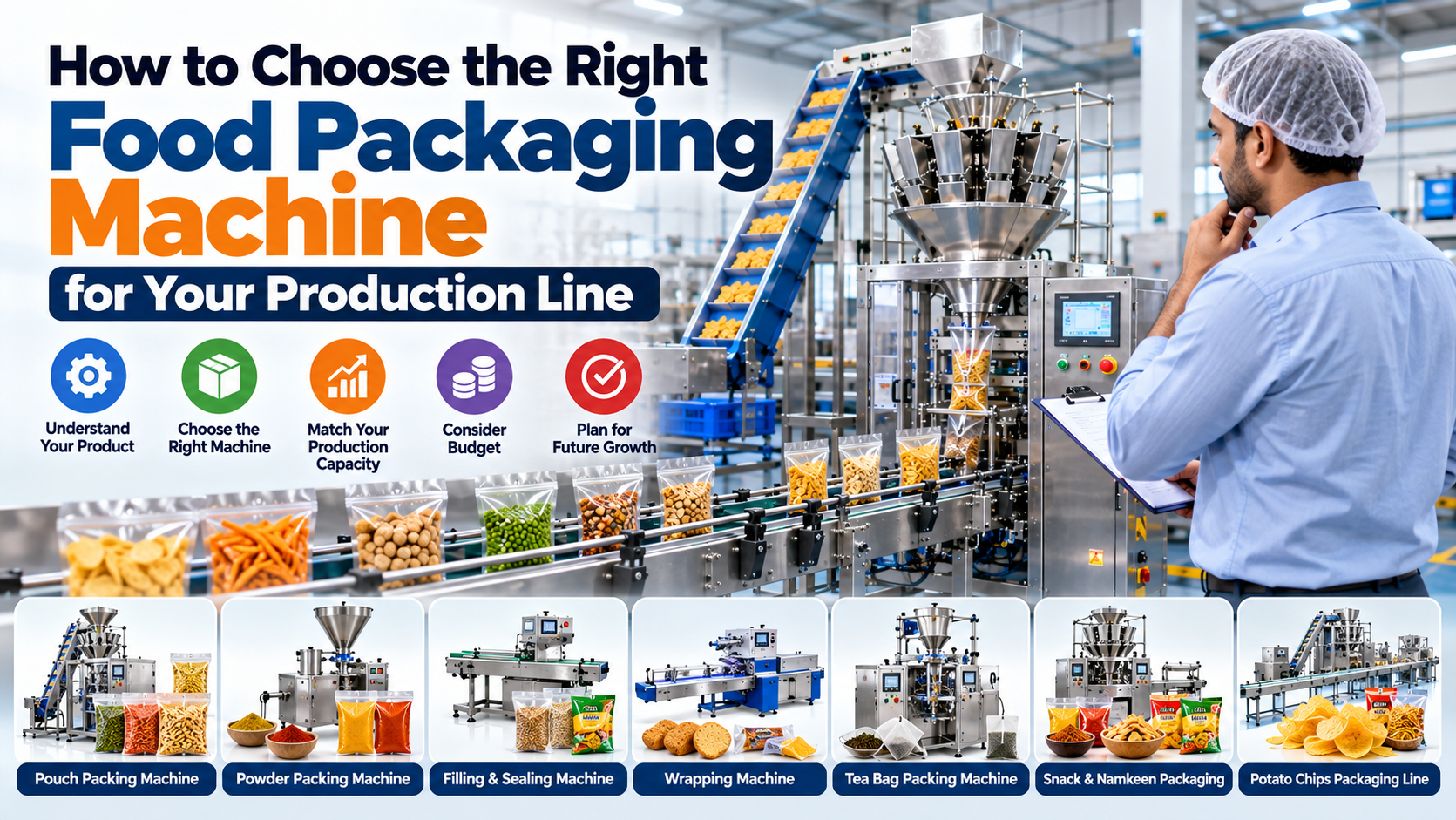
Choosing the right food packaging machine is an important decision for any food-processing business. The machine you select can affect production capacity, packaging consistency, labour requirements, operating costs and the ability to expand your business.
Whether you manufacture spices, namkeen, snacks, grains, pulses, tea, bakery products or other packaged foods, there is no single packaging machine that works for every application.
The right equipment depends on several factors, including product type, pack size, production volume, packaging material, filling method, automation level and available factory space.
This guide explains the key factors you should evaluate before purchasing food packaging machinery for your production line in India.
Why Choosing the Right Packaging Machine Matters
A packaging machine is a long-term investment. Selecting equipment without properly understanding your requirements can lead to production limitations, unnecessary costs or compatibility problems.
The right machine can help you achieve:
- Consistent packaging
- Improved production efficiency
- Better filling accuracy
- Reduced repetitive manual work
- Consistent sealing
- Improved production planning
- Easier future expansion
- Better utilization of packaging materials
The objective should be to select a machine that matches your current production requirements while leaving reasonable room for future growth.
1. Start With Your Food Product
The first question to ask is:
What type of food product will you package?
Different products behave differently during filling and packaging.
For example, a fine spice powder requires a different filling mechanism from a free-flowing grain or a lightweight snack.
Common Product Categories
Powders
- Turmeric
- Chilli powder
- Coriander
- Masala
- Flour
Granules
- Rice
- Pulses
- Sugar
- Seeds
- Grains
Snacks
- Namkeen
- Extruded snacks
- Corn snacks
- Potato chips
- Fried snacks
Other Products
- Tea
- Bakery products
- Dry foods
- Food ingredients
The physical characteristics of your product should be considered before selecting the filling and packaging technology.
2. Decide Your Packaging Format
The packaging format is another major consideration.
You may require:
- Pouches
- Sachets
- Wrapped packs
- Tea bags
- Bags
- Other flexible packaging formats
For example, a spice manufacturer selling retail pouches may need a pouch packing system, while a bakery manufacturer may require a wrapping machine.
Your packaging format should be decided before finalizing the machine configuration.
3. Determine Your Pack Sizes
Think about the sizes you currently sell and the sizes you may introduce later.
For example:
- 10 g
- 25 g
- 50 g
- 100 g
- 200 g
- 250 g
- 500 g
- 1 kg
A machine designed for a limited range may not be suitable if your business plans to offer multiple pack sizes.
Important Question
Will the machine support all your important pack sizes without extensive changeover or additional equipment?
Discuss this requirement with the machinery manufacturer before purchasing.
4. Calculate Your Required Production Capacity
Production capacity is one of the most important factors when selecting packaging machinery.
Calculate approximately:
Packets per hour × Operating hours per day = Daily Packaging Requirement
For example, if your business needs thousands of packets every day, a small manually operated system may not be suitable.
At the same time, buying a significantly oversized machine may increase capital costs without providing a practical benefit.
Consider Both Current and Future Demand
Think about:
- Current production
- Expected sales growth
- Number of shifts
- Seasonal demand
- New product launches
- Future pack sizes
The objective is to find a practical balance between current needs and future expansion.
5. Choose the Right Filling Technology
The filling system should match the physical characteristics of your product.
Powder Products
Powders may require specialized dosing and filling mechanisms.
Granular Products
Rice, pulses, seeds and similar products generally require systems designed for granular materials.
Snack Products
Irregular or fragile snacks may require weighing and handling systems designed to minimize product damage.
Tea
Tea products may require specialized filling and packaging systems depending on the final package format.
Selecting the correct filling technology is essential for reliable packaging performance.
6. Consider the Packaging Material
Your packaging material must be compatible with the selected machine.
Depending on your packaging format, you may use different types of flexible packaging materials.
Consider:
- Film thickness
- Film width
- Film structure
- Sealing characteristics
- Packaging format
- Product requirements
Ask the manufacturer to confirm compatibility with your actual packaging material.
Whenever possible, conducting a machine trial with the intended product and packaging film can provide useful information before purchase.
7. Decide the Required Automation Level
Packaging machinery can range from relatively simple systems to highly automated production lines.
Manual Packaging
Suitable for very low production volumes where investment in automation is not yet justified.
Semi-Automatic Packaging
Some processes are automated while operators handle other stages.
Automatic Packaging
Multiple stages can be integrated into a more automated workflow.
A growing business may start with semi-automatic machinery and later add conveyors, weighing systems or additional automation.
8. Evaluate Machine Speed Properly
Machine manufacturers may specify a maximum operating speed, but actual production can vary.
Output may depend on:
- Product characteristics
- Pack size
- Filling method
- Packaging film
- Operator settings
- Machine configuration
- Product feeding system
- Changeover time
Therefore, don’t evaluate machinery only by its maximum advertised speed.
Ask for expected production output for your actual product and pack size.
9. Check Machine Construction and Hygiene
Food packaging machinery operates in a food-production environment, so construction and cleanability are important considerations.
Features to evaluate include:
- Food-grade contact surfaces
- Stainless-steel construction where appropriate
- Accessible cleaning areas
- Easy maintenance
- Suitable machine design
- Protection from unnecessary contamination
The specific material grade and design should be evaluated according to the product and applicable food-industry requirements.
10. Consider Factory Space
Before purchasing equipment, measure the available installation area.
Don’t consider only the machine footprint.
You may also need space for:
- Product feeding
- Operators
- Packaging film
- Finished products
- Maintenance
- Electrical panels
- Conveyors
- Material movement
A complete production-line layout should allow operators and maintenance personnel to access the equipment safely and efficiently.
11. Think About Changeover Requirements
If your business packages multiple products or pack sizes, changeover time becomes important.
For example, a manufacturer may package:
100 g Masala → 250 g Masala → 500 g Masala
If changing between products or sizes requires lengthy manual adjustments, production efficiency can be affected.
Ask the manufacturer:
- How is the machine adjusted?
- How long does typical changeover take?
- Which components need to be changed?
- Can different pack sizes be handled?
- How easy is cleaning between products?
12. Evaluate Maintenance Requirements
A packaging machine is only useful when it remains operational.
Before purchasing, understand:
- Routine maintenance requirements
- Spare parts availability
- Consumable components
- Service intervals
- Cleaning procedures
- Technical support
- Troubleshooting process
A supplier with accessible technical support can be valuable, particularly for businesses that are new to packaging automation.
13. Consider After-Sales Support
The purchase price is only one part of the total investment.
Ask about:
- Installation
- Commissioning
- Operator training
- Technical support
- Spare parts
- Maintenance
- Warranty
- Service availability
A machine that fits your production requirements but lacks adequate technical support may create operational challenges later.
14. Calculate Total Cost of Ownership
Instead of considering only the purchase price, evaluate the overall cost of operating the machine.
Consider:
Purchase Cost + Installation + Utilities + Maintenance + Spare Parts + Labour + Packaging Material Efficiency
This gives you a better understanding of the machine’s long-term economics.
15. Think About Future Expansion
Your packaging requirements may increase as your business grows.
For example:
Today
1,000 packets/day
Future
5,000 packets/day
If your machine cannot accommodate increased production, you may need another investment sooner than expected.
Consider whether the equipment can later be integrated with:
- Conveyors
- Automatic weighing
- Additional feeding systems
- Coding systems
- Inspection systems
- Additional packaging machines
A scalable approach can help businesses build their production line gradually.
Which Food Packaging Machine Do You Need?
The following table provides a simple starting point.
| Product / Application | Possible Packaging Solution |
|---|---|
| Spice Powder | Powder Packing Machine |
| Masala | Powder/Pouch Packing Machine |
| Rice & Pulses | Granule Packing Machine |
| Namkeen | Weighing + Pouch Packing |
| Corn Snacks | Snack Packaging System |
| Potato Chips | Chips Processing + Packaging |
| Tea | Tea Bag Packing Machine |
| Bakery Products | Wrapping Machine |
| Dry Food Products | Pouch Packing System |
The final machine selection should be based on the actual product and production requirements.
Questions to Ask Before Buying
Before requesting a quotation, prepare the following information:
Product Information
- What product are you packaging?
- What is its physical form?
- Is it powder, granule, solid or snack?
Packaging Information
- What pouch or package format do you need?
- What packaging material will you use?
- What pack sizes are required?
Production Information
- How many packets do you produce per day?
- How many shifts do you operate?
- What production capacity do you expect in the future?
Machine Information
- What automation level do you require?
- What factory space is available?
- What electrical supply is available?
- What additional equipment is required?
Having this information ready can make the machine-selection process much easier.
Why Choose Hind Food Packaging?
Hind Food Packaging provides machinery and equipment for different food-processing and packaging applications.
Its range includes solutions associated with:
- Pouch packaging
- Powder packaging
- Wrapping
- Snack packaging
- Potato processing
- Food extrusion
- Roasting
- Grinding
- Conveying
- Tea packaging
For each application, the appropriate machine depends on the product, packaging format, production capacity and automation requirements.
Businesses can discuss their specific requirements with Hind Food Packaging to determine a suitable machinery configuration.
Final Checklist Before Purchasing
Use this checklist before placing your machinery order:
☑ Product type identified
☑ Pack sizes finalized
☑ Production capacity calculated
☑ Packaging material selected
☑ Filling technology evaluated
☑ Automation level decided
☑ Factory space measured
☑ Machine trial considered
☑ Maintenance requirements understood
☑ Spare-parts availability checked
☑ Installation support confirmed
☑ Operator training discussed
☑ After-sales support evaluated
☑ Future production requirements considered
Conclusion
Choosing the right food packaging machine for your production line requires careful evaluation of your product, packaging format and business requirements.
The best machine is not necessarily the most expensive or the fastest. It is the machine that provides the right combination of capacity, accuracy, packaging compatibility, automation, maintenance and scalability for your operation.