
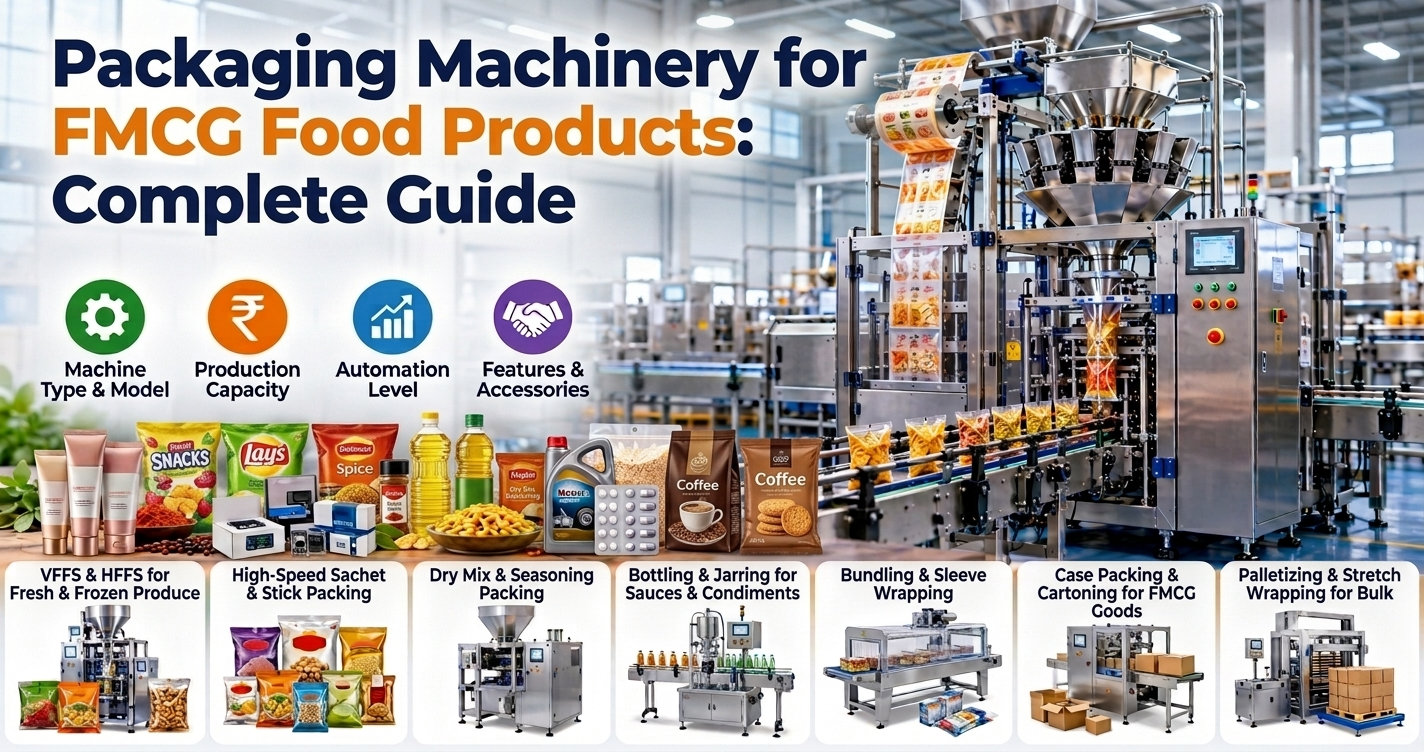
The FMCG food industry requires fast, consistent, hygienic, and efficient packaging to meet growing consumer demand. From spices and grains to snacks, pulses, dry fruits, and other food products, packaging plays an important role in protecting products and maintaining their quality.
As production volumes increase, manual packaging can become time-consuming and difficult to manage. Packaging machinery provides a practical solution by automating processes such as weighing, filling, sealing, coding, and conveying.
This complete guide explains the different types of packaging machinery used for FMCG food products and the important factors businesses should consider when selecting packaging equipment.
What Is FMCG Food Packaging?
FMCG stands for Fast-Moving Consumer Goods. FMCG food products are items that are regularly purchased and consumed by customers.
Examples include:
- Spices and masala
- Pulses
- Rice
- Flour
- Sugar and salt
- Snacks and namkeen
- Dry fruits
- Seeds
- Cereals and grains
- Processed food products
These products often require efficient packaging because they are manufactured and distributed in large quantities.
Why Is Packaging Machinery Important for FMCG Food Products?
FMCG businesses often need to package thousands of products within a limited period. Manual packaging can make it difficult to maintain speed and consistency as production increases.
Packaging machinery can help businesses:
- Increase production speed
- Reduce repetitive manual labour
- Improve filling accuracy
- Maintain consistent pack weights
- Reduce product wastage
- Improve sealing consistency
- Handle higher production volumes
- Create a smoother packaging workflow
The right machinery can therefore become an important part of an efficient FMCG production process.
Types of Packaging Machinery for FMCG Food Products
Different FMCG products require different packaging systems. The machinery should be selected according to the product characteristics, packaging format, required capacity, and production process.
1. Weighing and Filling Machines
Weighing and filling machines are used to measure a specific quantity of product and transfer it into the packaging.
They can be used for products such as:
- Pulses
- Rice
- Grains
- Spices
- Dry fruits
- Seeds
- Granular food products
Accurate weighing helps maintain consistent pack quantities and can reduce unnecessary product giveaway.
2. Pouch Packing Machines
Pouch packing machines are widely used for FMCG food products packed in flexible packaging.
Depending on the machine configuration, pouch packing systems can perform operations such as:
- Pouch forming
- Product filling
- Sealing
- Cutting
- Pack discharge
The machine should be selected according to the required pouch size, product type, filling range, and packaging material.
3. Sealing Machines
Sealing equipment is used to close food packages securely.
Proper sealing can help protect products from external exposure and maintain package integrity during storage, handling, and transportation.
Different products and packaging materials may require different sealing arrangements.
4. Automatic Packaging Machines
Automatic packaging machines are designed to reduce manual intervention and improve production efficiency.
Depending on the setup, an automatic line may integrate:
Feeding → Weighing → Filling → Sealing → Coding → Conveying
These systems are particularly useful for businesses handling larger production volumes.
5. Conveyor Systems
Conveyors help transfer products or finished packages between different stages of production.
They can reduce manual handling and connect multiple machines into a more organized packaging workflow.
Packaging Machinery for Different FMCG Food Products
The appropriate packaging machinery depends heavily on the product being packed.
Spices and Masala
Spices are commonly packaged in pouches or other flexible packaging formats. The filling system should be suitable for powder characteristics and the required pack weight.
Pulses and Grains
Pulses, rice, and grains are generally handled using suitable weighing and filling systems designed for granular products.
Snacks and Namkeen
Snacks can require careful product handling to reduce product breakage. Suitable feeding and filling systems should be selected according to the product characteristics.
Dry Fruits and Seeds
Dry fruits and seeds may require accurate weighing and gentle product handling during the filling process.
Flour and Powder Products
Powder products require filling systems designed to handle their flow and density characteristics while maintaining the required filling accuracy.
Manual, Semi-Automatic, or Automatic?
FMCG businesses can choose different levels of automation depending on production requirements.
Manual Packaging
Manual packaging can be suitable for small production volumes and businesses with limited initial machinery requirements.
However, it generally requires more labour and may provide lower production consistency.
Semi-Automatic Packaging
Semi-automatic machinery combines machine-assisted operations with manual intervention.
It can be a practical choice for growing FMCG businesses that want to improve productivity without immediately investing in a fully automatic line.
Automatic Packaging
Automatic machinery is suitable for businesses with higher production requirements.
It can perform multiple packaging operations with minimal manual intervention and provide greater production consistency.
Factors to Consider When Choosing FMCG Packaging Machinery
Before purchasing packaging machinery, businesses should carefully evaluate their requirements.
1. Product Characteristics
Consider whether the product is a powder, granular product, solid, snack, or another type of food product.
2. Production Capacity
Determine the required packs per minute and expected daily production.
3. Pack Size
Identify the required packaging weights and dimensions.
4. Packaging Material
The machine should be compatible with the packaging material and format being used.
5. Automation Level
Choose manual, semi-automatic, or automatic machinery according to production requirements.
6. Filling Accuracy
Accurate weighing and filling are important for maintaining consistent pack quantities and reducing product wastage.
7. Machine Construction
For food applications, hygiene, durability, ease of cleaning, and suitable product-contact materials should be considered.
8. Available Space
Check the available floor space before selecting the machine or complete packaging line.
9. Maintenance Requirements
Understand routine maintenance requirements, spare parts availability, and service support.
10. Future Expansion
Consider expected business growth before selecting machine capacity. A suitable system should ideally support future production requirements or allow upgrades where possible.
Benefits of Packaging Machinery for FMCG Businesses
Investing in suitable packaging machinery can provide several operational benefits.
Higher Productivity
Automated packaging can process more products within a given production period.
Consistent Packaging
Machines can maintain more consistent filling, sealing, and packaging operations.
Reduced Labour Requirements
Automation can reduce repetitive manual tasks and allow workers to focus on machine operation and quality control.
Lower Product Wastage
Accurate weighing and filling can help reduce unnecessary product loss.
Improved Workflow
Conveyors, feeders, filling systems, and sealing equipment can be integrated into a smoother production process.
Better Scalability
As an FMCG business grows, suitable packaging machinery can help support increased production requirements.
Common Mistakes to Avoid
Businesses should avoid selecting packaging machinery based only on the lowest purchase price.
Some common mistakes include:
- Ignoring actual production requirements
- Choosing the wrong filling system
- Not testing the machine with the actual product
- Focusing only on maximum advertised speed
- Ignoring spare parts availability
- Not considering future production growth
- Overlooking after-sales service
- Not checking available installation space
A machine should be evaluated based on its overall suitability and long-term value.
Questions to Ask a Packaging Machinery Manufacturer
Before purchasing, ask the manufacturer:
- What FMCG food products can the machine handle?
- What is the practical production capacity?
- What pack sizes are supported?
- What packaging materials can be used?
- What level of automation is available?
- Can the machine be customized?
- What is the filling accuracy?
- What are the power requirements?
- What installation support is provided?
- Are spare parts readily available?
- What warranty is provided?
- What after-sales service is available?
These questions can help businesses compare different machinery options more effectively.
Why Choose HIND Food Packaging?
HIND Food Packaging provides packaging machinery solutions for food processing and FMCG applications.
We understand that every FMCG business has different products, packaging formats, production capacities, and automation requirements. Our approach focuses on identifying suitable machinery according to the specific application.
Whether you are starting a new FMCG food production unit, upgrading an existing packaging process, or increasing your production capacity, selecting the right packaging machinery can help improve efficiency and maintain consistent packaging quality.
Conclusion
Packaging machinery plays an important role in the FMCG food industry by helping businesses improve production speed, filling accuracy, packaging consistency, and operational efficiency.
The right machine depends on several factors, including product type, pack size, production volume, packaging material, automation level, available space, and future growth requirements.
Instead of choosing machinery based only on price, businesses should evaluate performance, reliability, maintenance, customization options, spare parts, and after-sales support.
With the right packaging solution, FMCG food businesses can create a more efficient, consistent, and scalable packaging process.