
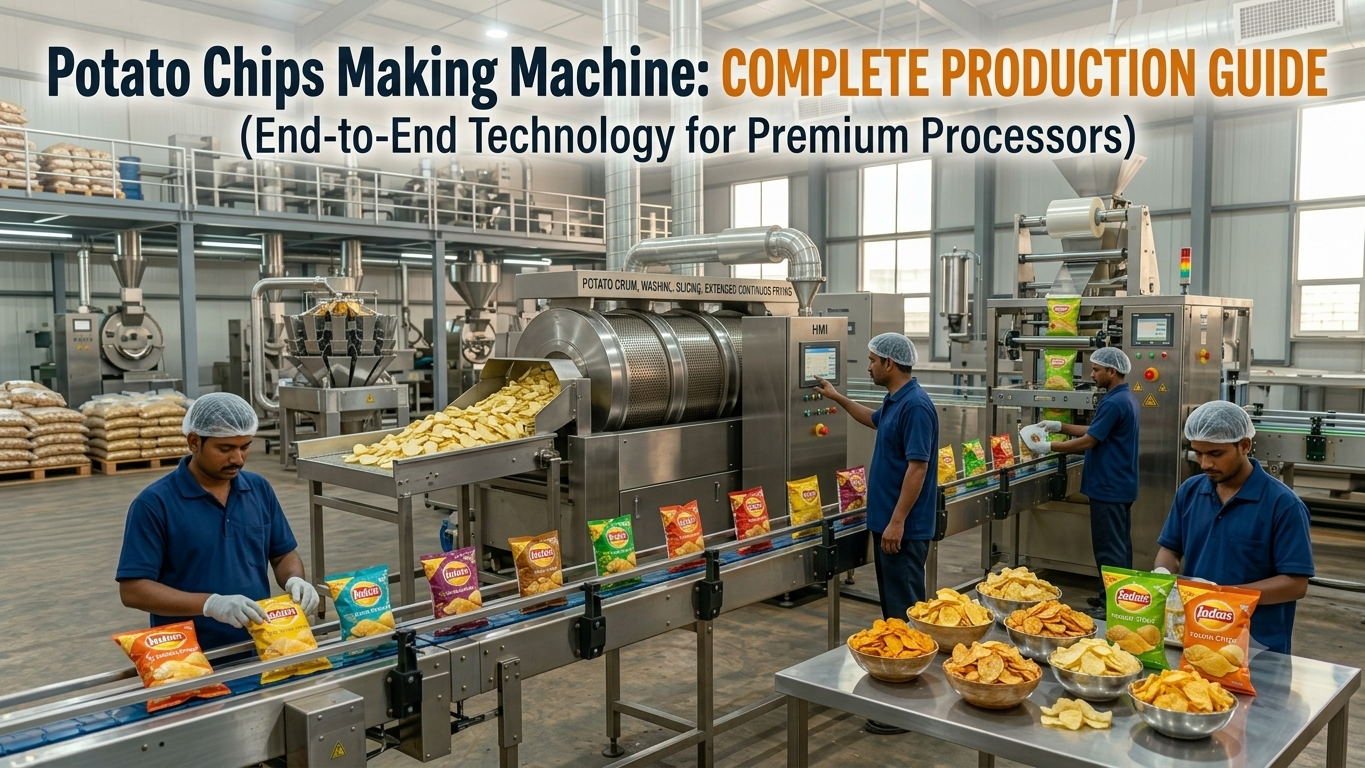
Potato chips are one of the most popular snack products in the food industry. With increasing demand for packaged snacks, manufacturers require efficient machinery to produce consistent-quality chips at commercial scale. A potato chips making machine helps automate important stages of production, including potato preparation, slicing, washing, frying, seasoning, and packaging.
A properly designed potato chips production line can help manufacturers improve production efficiency, maintain consistent product quality, reduce manual work, and achieve uniform packaging.
What Is a Potato Chips Making Machine?
A potato chips making machine is a food processing system used to automate different stages of potato chip production. Depending on the production capacity and configuration, the machinery can include potato washing and peeling equipment, slicing machines, blanching systems, dewatering equipment, fryers, seasoning systems, conveyors, and packaging machines.
The equipment required depends on the type of chips, production volume, processing method, and desired level of automation.
Potato Chips Production Process
The basic potato chips manufacturing process involves several important stages.
1. Potato Selection
Good-quality potatoes are selected based on size, variety, maturity, and suitability for chips production. Consistent raw material quality helps achieve better final product quality.
2. Washing and Cleaning
The potatoes are thoroughly washed to remove soil, dirt, and other unwanted materials from the surface.
3. Peeling
Depending on the product and production setup, potatoes may be peeled mechanically before slicing.
4. Slicing
A potato slicing machine cuts the potatoes into thin and uniform slices. Consistent slice thickness is important for achieving even frying and a uniform final product.
5. Washing and Blanching
The sliced potatoes may be washed or blanched according to the production process. This can help remove excess surface starch and prepare the slices for subsequent processing.
6. Dewatering
Excess water is removed from the potato slices before frying. Proper dewatering can help improve frying efficiency and product consistency.
7. Frying
The potato slices are fried under controlled conditions until they achieve the desired texture, colour, and crispiness.
8. Seasoning
After frying and cooling, the chips can be mixed with salt, spices, or other suitable seasonings according to the product formulation.
9. Cooling
The chips are cooled before packaging to help maintain product quality and prepare them for the packaging stage.
10. Packaging
The finished chips are weighed, filled into pouches, and sealed using a suitable snack packaging machine. Nitrogen flushing may also be used in suitable packaging applications to help protect product quality.
Main Machines Used in Potato Chips Production
A commercial potato chips production line may include several types of equipment.
Potato Washing Machine
Used to clean potatoes and remove soil and surface impurities before further processing.
Potato Peeling Machine
Mechanical peeling equipment can help remove the potato skin efficiently while reducing manual processing.
Potato Slicing Machine
A slicing machine produces potato slices with consistent thickness, helping improve frying uniformity.
Blanching Equipment
Blanching equipment can be incorporated into suitable production processes to prepare potato slices before frying.
Dewatering Machine
This equipment helps remove excess water from sliced potatoes before they enter the frying stage.
Potato Chips Fryer
Industrial frying equipment provides controlled frying conditions for producing crispy and evenly cooked chips.
Seasoning Machine
A seasoning system helps distribute salt and spices evenly over the finished chips.
Packaging Machine
Packaging machinery weighs and fills the chips into pouches before sealing them for storage, transportation, and retail sale.
Benefits of Potato Chips Making Machines
Higher Production Capacity
Automated machinery allows manufacturers to process larger quantities of potatoes efficiently and maintain a continuous production flow.
Consistent Slice Thickness
Automatic slicing helps produce uniform slices, which can contribute to consistent frying and product quality.
Improved Production Efficiency
Automation reduces repetitive manual operations and helps streamline the complete manufacturing process.
Better Hygiene
Reduced manual handling can help create a more controlled production environment, which is important for food manufacturing.
Consistent Product Quality
Controlled processing conditions can help manufacturers maintain more consistent texture, appearance, and seasoning across production batches.
Reduced Labour Requirement
Automated equipment can reduce the amount of manual work required at different stages of production.
Potato Chips Packaging
Packaging is an important part of potato chips manufacturing. Chips need packaging that helps protect them from moisture, contamination, and physical damage during storage and transportation.
A suitable pouch packing machine can automatically weigh, fill, and seal the finished chips. Depending on the packaging requirements, manufacturers can choose suitable pouch sizes and packaging formats.
How to Choose the Right Potato Chips Making Machine?
Before investing in potato chips manufacturing machinery, manufacturers should evaluate several factors:
Production Capacity: Determine the required output per hour or per day.
Level of Automation: Choose between semi-automatic and fully automatic machinery according to production requirements.
Potato Quality: Consider the type and characteristics of potatoes used for production.
Slice Thickness: Ensure that the slicing equipment can produce the required thickness consistently.
Frying System: Select suitable frying equipment based on the desired product characteristics and production capacity.
Seasoning Requirements: Consider the type and quantity of seasoning to be applied.
Packaging Size: Determine the required pouch weights, sizes, and packaging formats.
Maintenance and Support: Check spare-parts availability, installation, operator training, maintenance, and after-sales support.
Small-Scale vs Large-Scale Potato Chips Production
Small-scale manufacturers may prefer compact or semi-automatic machinery that requires lower initial investment and can handle moderate production volumes.
Large-scale manufacturers generally require automated production lines capable of continuous processing and higher output. The machinery can be integrated with conveyors, frying systems, seasoning equipment, and automatic packaging machines to create a complete production line.
Why Invest in Potato Chips Manufacturing Machinery?
The growing demand for packaged snacks has increased the need for efficient and consistent production systems. Potato chips making machines can help manufacturers streamline processing, improve production capacity, reduce manual operations, and maintain consistent product quality.
When combined with an efficient packaging system, the complete production line can provide a smoother transition from raw potatoes to finished, packaged chips.
Conclusion
A potato chips making machine can help food manufacturers automate and streamline the production of potato chips. From washing and slicing to frying, seasoning, cooling, and packaging, the right combination of machinery can improve efficiency and product consistency.
Before selecting equipment, manufacturers should consider production capacity, product requirements, automation level, machine configuration, packaging needs, maintenance, and after-sales support. Choosing machinery according to actual production requirements can help create a reliable and efficient potato chips manufacturing process.